ginger's thoughts

Silvia's blog

Category: FOMS

WebVTT Discussions at FOMS

At the recent FOMS (Foundations of Open Media Software and Standards) Developer Workshop, we had a massive focus on WebVTT and the state of its feature set. You will find links to summaries of the individual discussions in the FOMS Schedule page. Here are some of the key results I went away with.

1. WebVTT Regions

The key driving force for improvements to WebVTT continues to be the accurate representation of CEA608/708 captioning. As part of that drive, we’ve introduced regions (the CEA708 “window” concept) to WebVTT. WebVTT regions satisfy multiple requirements of CEA608/708 captions:

  1. support for rollup captions
  2. support for background color and border color on a group of cues independent of the background color of the individual cue
  3. possibility to move a group of cues from one location on screen to a different
  4. support to specify an anchor point and a growth direction for cues when their text size changes
  5. support for specifying a fixed number of lines to be rendered
  6. possibility to specify which region is rendered in front of which other one when regions overlap

While WebVTT regions enable us to satisfy all of the above points, the specification isn’t actually complete yet and some of the above needs aren’t satisfied yet.

We have an open bug to move a region elsewhere. A first discussion at FOMS seemed to to indicate that we’ll have to add syntax for updating a region at a particular time and thus give region definitions a way to be valid only for a certain time frame. I can imagine that the region definitions that we have in the header of the WebVTT file now would have an implicitly defined time frame from the start to the end of the file, but can be overruled by a re-definition anywhere within the WebVTT file. That redefinition needs to provide a start and end time.

We registered a bug to add specifying the width and height of regions (and possibly of cues) by em (i.e. by multiples of the largest character in a font). This should allow us to have the region grow/shrink around the region anchor point with a change of font size by script or a user. em specifications should also be applied to cues - that matches the column count of CEA708/608 better.

When regions overlap, the original region extension spec already suggested a “layer” cue setting. It will be easy to add it.

Another change that we will ultimately need is the “scroll” setting: we will need to introduce support for scrolling text down or from left-to-right or right-to-left, e.g. vertical scrolling text seems to be used in some Chinese caption use cases.

2. Unify Rendering Approach

The introduction of regions created a second code path in the rendering spec with some duplication. At FOMS we discussed if it was possible to unify that. The suggestion is to render all cues into a region. Those that are not part of a region would be rendered into an anonymous region that covers the complete viewport. There may be some consequences to this, e.g. cue settings should be usable across all cues, no matter whether or not part of a region, and avoiding cue overlap may need to be done within regions.

Here’s a rough outline of the path of the new rendering algorithm:

(1) Render the regions:

Specified RegionAnonymous Region
Render values as given:Render following values:
- width - lines - regionanchor - viewportanchor - scroll- 100% - videoheight/lineheight - 0,0 - 0,0 - none

(2) Render the cues:

  • Create a cue box and put it in its region (anonymous if none given).
  • Calculate position & size of cue box from cue settings (position, line, size).
  • Calculate position of cue text inside cue box from remaining cue settings (vertical, align).

3. Vertical Features

WebVTT includes vertical rendering, both right-to-left and left-to-right. However, regions are not defined for vertical. Eventually, we’re going to have to look at the vertical features of WebVTT with more details and figure out whether the spec is working for them and what real-world requirements we have missed. We hope we can get some help from users in countries where vertically rendered captions/subtitles are the norm.

4. Best Practices

Some of he WebVTT users at FOMS suggested it would be advantageous to start a list of “best practices” for how to author captions with WebVTT. Example recommendations are:

  • Use line numbers only to position cues from top or bottom of viewport. Don’t use otherwise.
  • Note that when the user increases the fontsize in rollup captions and thus introduces new line breaks, your cues will roll by faster because the number of lines of a rollup is fixed.
  • Make sure to use ‎ and ‏ UTF-8 markers to control the directionality of your text.

It would be nice if somebody started such a document.

5. Non-caption use cases

Instead of continuing to look back and improve our support of captions/subtitles in WebVTT, one session at FOMS also went ahead and looked forward to other use cases. The following requirements came out of this:

5.1 Preview Thumbnails

A common use case for timed data is the use of preview thumbnails on the navigation bar of videos. A native implementation of preview thumbnails would allow crawlers and search engines to have a standardised way of extracting timed images for media files, so introduction of a new @kind value “thumbnails” was suggested.

The content of a “thumbnails” cue could be any of:

  • an image URL
  • a sprite URL to a single image
  • a spatial & temporal media fragment URL to a media resource
  • base64 encoded image (data URI)
  • an iframe offset to the media resource

The suggestion is to allow anything that would work in a img @src attribute as value in a cue of @kind=“thumbnails”. Responsive images might also be useful for a track of @kind=“thumbnails”. It may even be possible to define an inband thumbnail track based on the track of @kind=“thumbnails”. Such cues should also work in the JavaScript track API.

5.2 Chapter markers

There is interest to put richer content than just a chapter title into chapter cues. Often, chapters consist of a title, text and and image. The text is not so important, but the image is used almost everywhere that chapters are used. There may be a need to extend chapter cue content with images, similar to what a @kind=“thumbnails” track offers.

The conclusion that we arrived at was that we need to make @kind=“thumbnails” work first and then look at using the learnings from that to extend @kind=“chapters”.

5.3 Inband tracks for live video

A difficult topic was opened with the question of how to transport text tracks in live video. In live captioning, end times are never created for cues, but are implied by the start time of the next cue. This is a use case that hasn’t been addressed in HTML5/WebVTT yet. An old proposal to allow a special end time value of “NEXT” was discussed and recommended for adoption. Also, there was support for the spec change that stops blocking loading VTT until all cues have been loaded.

5.4 Cross-domain VTT loading

A brief discussion centered around the fact that the spec disallows cross-domain loading of WebVTT files, but that no browser implements this. This needs to be discussion at the HTML WG level.

6. Regions in live captioning

The final topic that we discussed was how we could provide support for regions in live captioning.

  • The currently active region definitions will need to be come part of every header of every VTT file segment that HLS uses, so it’s available in case the cues in the segment file reference it.
  • “NEXT” in end time markers would make authoring of live captioned VTT files easier.
  • If the application wants to use 1 word at a time and doesn’t want to delay sending the word until the full cue is authored (e.g. in a Hangout type environment), we will need to introduce the concept of “cue continuation markers”, so we know that a cue could be extended with the next VTT file fragment.

This is an extensive and impressive amount of discussion around WebVTT and a lot of new work to be performed in the future. I’m very grateful for all the people who have contributed to these discussions at FOMS and will hopefully continue to help get the specifications right.
WebVTT as a W3C Recommendation

Three weeks ago I attended TPAC, the annual meeting of W3C Working Groups. One of the meetings was of the Timed Text Working Group (TT-WG), that has been specifying TTML, the Timed Text Markup Language. It is now proposed that WebVTT be also standardised through the same Working Group.

How did that happen, you may ask, in particular since WebVTT and TTML have in the past been portrayed as rival caption formats? How will the WebVTT spec that is currently under development in the Text Track Community Group (TT-CG) move through a Working Group process?

I’ll explain first why there is a need for WebVTT to become a W3C Recommendation, and then how this is proposed to be part of the Timed Text Working Group deliverables, and finally how I can see this working between the TT-CG and the TT-WG.

Advantages of a W3C Recommendation

TTML is a XML-based markup format for captions developed during the time that XML was all the hotness. It has become a W3C standard (a so-called “Recommendation”) despite not having been implemented in any browsers (if you ask me: that’s actually a flaw of the W3C standardisation process: it requires only two interoperable implementations of any kind – and that could be anyone’s JavaScript library or Flash demonstrator – it doesn’t actually require browser implementations. But I digress…). To be fair, a subpart of TTML is by now implemented in Internet Explorer, but all the other major browsers have thus far rejected proposals of implementation.

Because of its Recommendation status, TTML has become the basis for several other caption standards that other SDOs have picked: the SMPTE’s SMPTE-TT format, the EBU’s EBU-TT format, and the DASH Industry Forum’s use of SMPTE-TT. SMPTE-TT has also become the “safe harbour” format for the US legislation on captioning as decided by the FCC. (Note that the FCC requirements for captions on the Web are actually based on a list of features rather than requiring a specific format. But that will be the topic of a different blog post…)

WebVTT is much younger than TTML. TTML was developed as an interchange format among caption authoring systems. WebVTT was built for rendering in Web browsers and with HTML5 in mind. It meets the requirements of the element and supports more than just captions/subtitles. WebVTT is popular with browser developers and has already been implemented in all major browsers (Firefox Nightly is the last to implement it – all others have support already released).

As we can see and as has been proven by the HTML spec and multiple other specs: browsers don’t wait for specifications to have W3C Recommendation status before they implement them. Nor do they really care about the status of a spec – what they care about is whether a spec makes sense for the Web developer and user communities and whether it fits in the Web platform. WebVTT has obviously achieved this status, even with an evolving spec. (Note that the spec tries very hard not to break backwards compatibility, thus all past implementations will at least be compatible with the more basic features of the spec.)

Given that Web browsers don’t need WebVTT to become a W3C standard, why then should we spend effort in moving the spec through the W3C process to become a W3C Recommendation?

The modern Web is now much bigger than just Web browsers. Web specifications are being used in all kinds of devices including TV set-top boxes, phone and tablet apps, and even unexpected devices such as white goods. Videos are increasingly omnipresent thus exposing deaf and hard-of-hearing users to ever-growing challenges in interacting with content on diverse devices. Some of these devices will not use auto-updating software but fixed versions so can’t easily adapt to new features. Thus, caption producers (both commercial and community) need to be able to author captions (and other video accessibility content as defined by the HTML5 element) towards a feature set that is clearly defined to be supported by such non-updating devices.

Understandably, device vendors in this space have a need to build their technology on standardised specifications. SDOs for such device technologies like to reference fixed specifications so the feature set is not continually updating. To reference WebVTT, they could use a snapshot of the specification at any time and reference that, but that’s not how SDOs work. They prefer referencing an officially sanctioned and tested version of a specification – for a W3C specification that means creating a W3C Recommendation of the WebVTT spec.

Taking WebVTT on a W3C recommendation track is actually advantageous for browsers, too, because a test suite will have to be developed that proves that features are implemented in an interoperable manner. In summary, I can see the advantages and personally support the effort to take WebVTT through to a W3C Recommendation.

Choice of Working Group

FAIK this is the first time that a specification developed in a Community Group is being moved into the recommendation track. This is something that has been expected when the W3C created CGs, but not something that has an established process yet.

The first question of course is which WG would take it through to Recommendation? Would we create a new Working Group or find an existing one to move the specification through? Since WGs involve a lot of overhead, the preference was to add WebVTT to the charter of an existing WG. The two obvious candidates were the HTML WG and the TT-WG – the first because it’s where WebVTT originated and the latter because it’s the closest thematically.

Adding a deliverable to a WG is a major undertaking. The TT-WG is currently in the process of re-chartering and thus a suggestion was made to add WebVTT to the milestones of this WG. TBH that was not my first choice. Since I’m already an editor in the HTML WG and WebVTT is very closely related to HTML and can be tested extensively as part of HTML, I preferred the HTML WG. However, adding WebVTT to the TT-WG has some advantages, too.

Since TTML is an exchange format, lots of captions that will be created (at least professionally) will be in TTML and TTML-related formats. It makes sense to create a mapping from TTML to WebVTT for rendering in browsers. The expertise of both, TTML and WebVTT experts is required to develop a good mapping – as has been shown when we developed the mapping from CEA608/708 to WebVTT. Also, captioning experts are already in the TT-WG, so it helps to get a second set of eyes onto WebVTT.

A disadvantage of moving a specification out of a CG into a WG is, however, that you potentially lose a lot of the expertise that is already involved in the development of the spec. People don’t easily re-subscribe to additional mailing lists or want the additional complexity of involving another community (see e.g. this email).

So, a good process needs to be developed to allow everyone to contribute to the spec in the best way possible without requiring duplicate work. How can we do that?

The forthcoming process

At TPAC the TT-WG discussed for several hours what the next steps are in taking WebVTT through the TT-WG to recommendation status (agenda with slides). I won’t bore you with the different views – if you are keen, you can read the minutes.

What I came away with is the following process:

  1. Fix a few more bugs in the CG until we’re happy with the feature set in the CG. This should match the feature set that we realistically expect devices to implement for a first version of the WebVTT spec.
  2. Make a FSA (Final Specification Agreement) in the CG to create a stable reference and a clean IPR position.
  3. Assuming that the TT-WG’s charter has been approved with WebVTT as a milestone, we would next bring the FSA specification into the TT-WG as FPWD (First Public Working Draft) and immediately do a Last Call which effectively freezes the feature set (this is possible because there has already been wide community review of the WebVTT spec); in parallel, the CG can continue to develop the next version of the WebVTT spec with new features (just like it is happening with the HTML5 and HTML5.1 specifications).
  4. Develop a test suite and address any issues in the Last Call document (of course, also fix these issues in the CG version of the spec).
  5. As per W3C process, substantive and minor changes to Last Call documents have to be reported and raised issues addressed before the spec can progress to the next level: Candidate Recommendation status.
  6. For the next step - Proposed Recommendation status - an implementation report is necessary, and thus the test suite needs to be finalized for the given feature set. The feature set may also be reduced at this stage to just the ones implemented interoperably, leaving any other features for the next version of the spec.
  7. The final step is Recommendation status, which simply requires sufficient support and endorsement by W3C members.

The first version of the WebVTT spec naturally has a focus on captioning (and subtitling), since this has been the dominant use case that we have focused on this far and it’s the part that is the most compatibly implemented feature set of WebVTT in browsers. It’s my expectation that the next version of WebVTT will have a lot more features related to audio descriptions, chapters and metadata. Thus, this seems a good time for a first version feature freeze.

There are still several obstacles towards progressing WebVTT as a milestone of the TT-WG. Apart from the need to get buy-in from the TT-WG, the TT-CG, and the AC (Adivisory Committee who have to approve the new charter), we’re also looking at the license of the specification document.

The CG specification has an open license that allows creating derivative work as long as there is attribution, while the W3C document license for documents on the recommendation track does not allow the creation of derivative work unless given explicit exceptions. This is an issue that is currently being discussed in the W3C with a proposal for a CC-BY license on the Recommendation track. However, my view is that it’s probably ok to use the different document licenses: the TT-WG will work on WebVTT 1.0 and give it a W3C document license, while the CG starts working on the next WebVTT version under the open CG license. It probably actually makes sense to have a less open license on a frozen spec.

Making the best of a complicated world

WebVTT is now proposed as part of the recharter of the TT-WG. I have no idea how complicated the process will become to achieve a W3C WebVTT 1.0 Recommendation, but I am hoping that what is outlined above will be workable in such a way that all of us get to focus on progressing the technology.

At TPAC I got the impression that the TT-WG is committed to progressing WebVTT to Recommendation status. I know that the TT-CG is committed to continue developing WebVTT to its full potential for all kinds of media-time aligned content with new kinds already discussed at FOMS. Let’s enable both groups to achieve their goals. As a consequence, we will allow the two formats to excel where they do: TTML as an interchange format and WebVTT as a browser rendering format.

Open Media Developers Track at OVC 2011

The Open Video Conference that took place on 10-12 September was so overwhelming, I’ve still not been able to catch my breath! It was a dense three days for me, even though I only focused on the technology sessions of the conference and utterly missed out on all the policy and content discussions.

Roughly 60 people participated in the Open Media Software (OMS) developers track. This was an amazing group of people capable and willing to shape the future of video technology on the Web:

  • HTML5 video developers from Apple, Google, Opera, and Mozilla (though we missed the NZ folks),
  • codec developers from WebM, Xiph, and MPEG,
  • Web video developers from YouTube, JWPlayer, Kaltura, VideoJS, PopcornJS, etc.,
  • content publishers from Wikipedia, Internet Archive, YouTube, Netflix, etc.,
  • open source tool developers from FFmpeg, gstreamer, flumotion, VideoLAN, PiTiVi, etc,
  • and many more.

To provide a summary of all the discussions would be impossible, so I just want to share the key take-aways that I had from the main sessions.

WebRTC: Realtime Communications and HTML5

Tim Terriberry (Mozilla), Serge Lachapelle (Google) and Ethan Hugg (CISCO) moderated this session together (slides). There are activities both at the W3C and at IETF - the ones at IETF are supposed to focus on protocols, while the W3C ones on HTML5 extensions.

The current proposal of a PeerConnection API has been implemented in WebKit/Chrome as open source. It is expected that Firefox will have an add-on by Q1 next year. It enables video conferencing, including media capture, media encoding, signal processing (echo cancellation etc), secure transmission, and a data stream exchange.

Current discussions are around the signalling protocol and whether SIP needs to be required by the standard. Further, the codec question is under discussion with a question whether to mandate VP8 and Opus, since transcoding gateways are not desirable. Another question is how to measure the quality of the connection and how to report errors so as to allow adaptation.

What always amazes me around RTC is the sheer number of specialised protocols that seem to be required to implement this. WebRTC does not disappoint: in fact, the question was asked whether there could be a lighter alternative than to re-use dozens of years of protocol development - is it over-engineered? Can desktop players connect to a WebRTC session?

We are already in a second or third revision of this part of the HTML5 specification and yet it seems the requirements are still being collected. I’m quietly confident that everything is done to make the lives of the Web developer easier, but it sure looks like a huge task.

Zohar Babin (Kaltura) and myself moderated this session and I must admit that this session was the biggest eye-opener for me amongst all the sessions. There was a large number of Flash developers present in the room and that was great, because sometimes we just don’t listen enough to lessons learnt in the past.

This session gave me one of those aha-moments: it the form of the Flash appendBytes() API function.

The appendBytes() function allows a Flash developer to take a byteArray out of a connected video resource and do something with it - such as feed it to a video for display. When I heard that Web developers want that functionality for JavaScript and the video element, too, I instinctively rejected the idea wondering why on earth would a Web developer want to touch encoded video bytes - why not leave that to the browser.

But as it turns out, this is actually a really powerful enabler of functionality. For example, you can use it to:

  • display mid-roll video ads as part of the same video element,
  • sequence playlists of videos into the same video element,
  • implement DVR functionality (high-speed seeking),
  • do mash-ups,
  • do video editing,
  • adaptive streaming.

This totally blew my mind and I am now completely supportive of having such a function in HTML5. Together with media fragment URIs you could even leave all the header download management for resources to the Web browser and just request time ranges from a video through an appendBytes() function. This would be easier on the Web developer than having to deal with byte ranges and making sure that appropriate decoding pipelines are set up.

Standards for Video Accessibility

Philip Jagenstedt (Opera) and myself moderated this session. We focused on the HTML5 track element and the WebVTT file format. Many issues were identified that will still require work.

One particular topic was to find a standard means of rendering the UI for caption, subtitle, und description selection. For example, what icons should be used to indicate that subtitles or captions are available. While this is not part of the HTML5 specification, it’s still important to get this right across browsers since otherwise users will get confused with diverging interfaces.

Chaptering was discussed and a particular need to allow URLs to directly point at chapters was expressed. I suggested the use of named Media Fragment URLs.

The use of WebVTT for descriptions for the blind was also discussed. A suggestion was made to use the voice tag to allow for “styling” (i.e. selection) of the screen reader voice.

Finally, multitrack audio or video resources were also discussed and the @mediagroup attribute was explained. A question about how to identify the language used in different alternative dubs was asked. This is an issue because @srclang is not on audio or video, only on text, so it’s a missing feature for the multitrack API.

Beyond this session, there was also a breakout session on WebVTT and the track element. As a consequence, a number of bugs were registered in the W3C bug tracker.

WebM: Testing, Metrics and New features

This session was moderated by John Luther and John Koleszar, both of the WebM Project. They started off with a presentation on current work on WebM, which includes quality testing and improvements, and encoder speed improvement. Then they moved on to questions about how to involve the community more.

The community criticised that communication of what is happening around WebM is very scarce. More sharing of information was requested, including a move to using open Google+ hangouts instead of Google internal video conferences. More use of the public bug tracker can also help include the community better.

Another pain point of the community was that code is introduced and removed without much feedback. It was requested to introduce a peer review process. Also it was requested that example code snippets are published when new features are announced so others can replicate the claims.

This all indicates to me that the WebM project is increasingly more open, but that there is still a lot to learn.

Standards for HTTP Adaptive Streaming

This session was moderated by Frank Galligan and Aaron Colwell (Google), and Mark Watson (Netflix).

Mark started off by giving us an introduction to MPEG DASH, the MPEG file format for HTTP adaptive streaming. MPEG has just finalized the format and he was able to show us some examples. DASH is XML-based and thus rather verbose. It is covering all eventualities of what parameters could be switched during transmissions, which makes it very broad. These include trick modes e.g. for fast forwarding, 3D, multi-view and multitrack content.

MPEG have defined profiles - one for live streaming which requires chunking of the files on the server, and one for on-demand which requires keyframe alignment of the files. There are clear specifications for how to do these with MPEG. Such profiles would need to be created for WebM and Ogg Theora, too, to make DASH universally applicable.

Further, the Web case needs a more restrictive adaptation approach, since the video element’s API is already accounting for some of the features that DASH provides for desktop applications. So, a Web-specific profile of DASH would be required.

Then Aaron introduced us to the MediaSource API and in particular the webkitSourceAppend() extension that he has been experimenting with. It is essentially an implementation of the appendBytes() function of Flash, which the Web developers had been asking for just a few sessions earlier. This was likely the biggest announcement of OVC, alas a quiet and technically-focused one.

Aaron explained that he had been trying to find a way to implement HTTP adaptive streaming into WebKit in a way in which it could be standardised. While doing so, he also came across other requirements around such chunked video handling, in particular around dynamic ad insertion, live streaming, DVR functionality (fast forward), constraint video editing, and mashups. While trying to sort out all these requirements, it became clear that it would be very difficult to implement strategies for stream switching, buffering and delivery of video chunks into the browser when so many different and likely contradictory requirements exist. Also, once an approach is implemented and specified for the browser, it becomes very difficult to innovate on it.

Instead, the easiest way to solve it right now and learn about what would be necessary to implement into the browser would be to actually allow Web developers to queue up a chunk of encoded video into a video element for decoding and display. Thus, the webkitSourceAppend() function was born (specification).

The proposed extension to the HTMLMediaElement is as follows:

partial interface HTMLMediaElement {
  // URL passed to src attribute to enable the media source logic.
  readonly attribute [URL] DOMString webkitMediaSourceURL;

  bool webkitSourceAppend(in Uint8Array data);

  // end of stream status codes.
  const unsigned short EOS_NO_ERROR = 0;
  const unsigned short EOS_NETWORK_ERR = 1;
  const unsigned short EOS_DECODE_ERR = 2;

  void webkitSourceEndOfStream(in unsigned short status);

  // states
  const unsigned short SOURCE_CLOSED = 0;
  const unsigned short SOURCE_OPEN = 1;
  const unsigned short SOURCE_ENDED = 2;

  readonly attribute unsigned short webkitSourceState;
};

The code is already checked into WebKit, but commented out behind a command-line compiler flag.

Frank then stepped forward to show how webkitSourceAppend() can be used to implement HTTP adaptive streaming. His example uses WebM - there are no examples with MPEG or Ogg yet.

The chunks that Frank’s demo used were 150 video frames long (6.25s) and 5s long audio. Stream switching only switched video, since audio data is much lower bandwidth and more important to retain at high quality. Switching was done on multiplexed files.

Every chunk requires an XHR range request - this could be optimised if the connections were kept open per adaptation. Seeking works, too, but since decoding requires download of a whole chunk, seeking latency is determined by the time it takes to download and decode that chunk.

Similar to DASH, when using this approach for live streaming, the server has to produce one file per chunk, since byte range requests are not possible on a continuously growing file.

Frank did not use DASH as the manifest format for his HTTP adaptive streaming demo, but instead used a hacked-up custom XML format. It would be possible to use JSON or any other format, too.

After this session, I was actually completely blown away by the possibilities that such a simple API extension allows. If I wasn’t sold on the idea of a appendBytes() function in the earlier session, this one completely changed my mind. While I still believe we need to standardise a HTTP adaptive streaming file format that all browsers will support for all codecs, and I still believe that a native implementation for support of such a file format is necessary, I also believe that this approach of webkitSourceAppend() is what HTML needs - and maybe it needs it faster than native HTTP adaptive streaming support.

Standards for Browser Video Playback Metrics

This session was moderated by Zachary Ozer and Pablo Schklowsky (JWPlayer). Their motivation for the topic was, in fact, also HTTP adaptive streaming. Once you leave the decisions about when to do stream switching to JavaScript (through a function such a wekitSourceAppend()), you have to expose stream metrics to the JS developer so they can make informed decisions. The other use cases is, of course, monitoring of the quality of video delivery for reporting to the provider, who may then decide to change their delivery environment.

The discussion found that we really care about metrics on three different levels:

  • measuring the network performance (bandwidth)
  • measuring the decoding pipeline performance
  • measuring the display quality

In the end, it seemed that work previously done by Steve Lacey on a proposal for video metrics was generally acceptable, except for the playbackJitter metric, which may be too aggregate to mean much.

Device Inputs / A/V in the Browser

I didn’t actually attend this session held by Anant Narayanan (Mozilla), but from what I heard, the discussion focused on how to manage permission of access to video camera, microphone and screen, e.g. when multiple applications (tabs) want access or when the same site wants access in a different session. This may apply to real-time communication with screen sharing, but also to photo sharing, video upload, or canvas access to devices e.g. for time lapse photography.

Open Video Editors

This was another session that I wasn’t able to attend, but I believe the creation of good open source video editing software and similar video creation software is really crucial to giving video a broader user appeal.

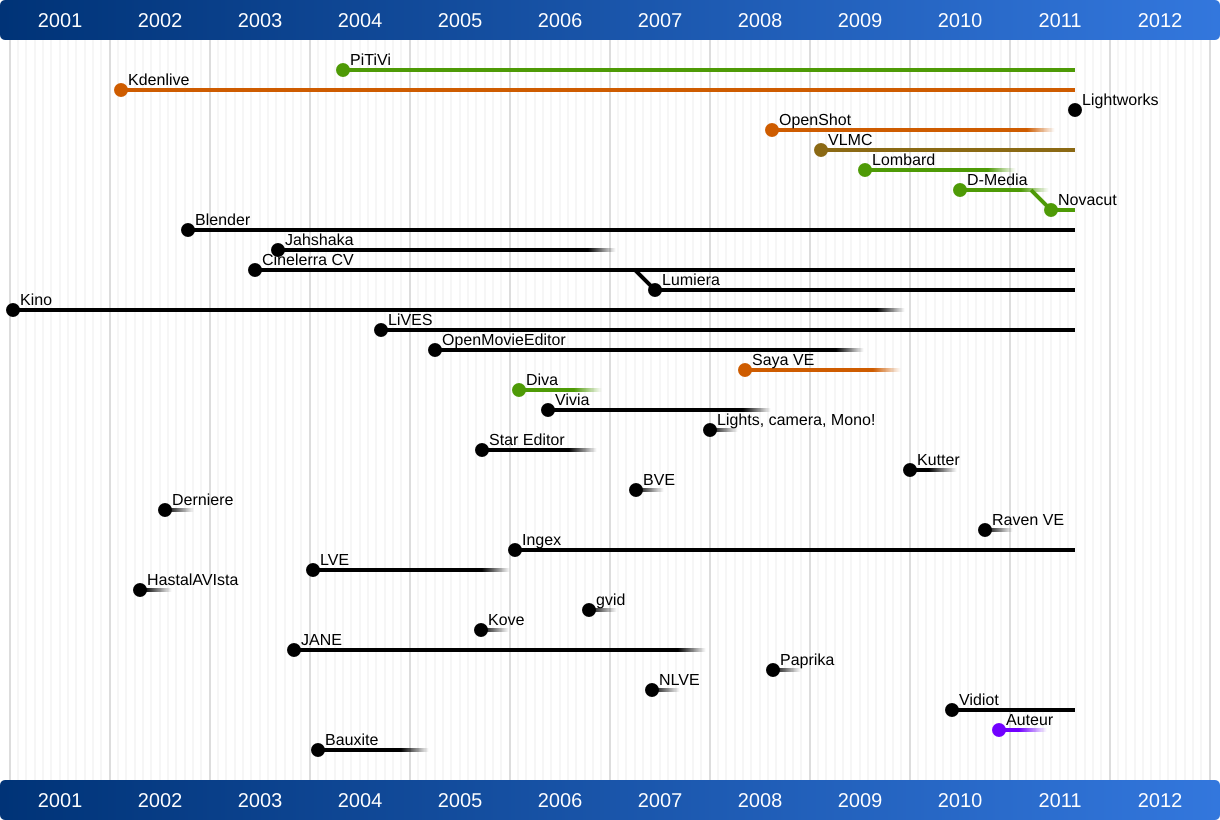
Jeff Fortin (PiTiVi) moderated this session and I was fascinated to later see his analysis of the lifecycle of open source video editors. It is shocking to see how many people/projects have tried to create an open source video editor and how many have stopped their project. It is likely that the creation of a video editor is such a complex challenge that it requires a larger and more committed open source project - single people will just run out of steam too quickly. This may be comparable to the creation of a Web browser (see the size of the Mozilla project) or a text processing system (see the size of the OpenOffice project).

Jeff also mentioned the need to create open video editor standards around playlist file formats etc. Possibly the Open Video Alliance could help. In any case, something has to be done in this space - maybe this would be a good topic to focus next year’s OVC on?

Monday’s Breakout Groups

The conference ended officially on Sunday night, but we had a third day of discussions / hackday at the wonderful New York Lawschool venue. We had collected issues of interest during the two previous days and organised the breakout groups on the morning (Schedule).

In the Content Protection/DRM session, Mark Watson from Netflix explained how their API works and that they believe that all we need in browsers is a secure way to exchange keys and an indicator of protection scheme is used - the actual protection scheme would not be implemented by the browser, but be provided by the underlying system (media framework/operating system). I think that until somebody actually implements something in a browser fork and shows how this can be done, we won’t have much progress. In my understanding, we may also need to disable part of the video API for encrypted content, because otherwise you can always e.g. grab frames from the video element into canvas and save them from there.

In the Playlists and Gapless Playback session, there was massive brainstorming about what new cool things can be done with the video element in browsers if playback between snippets can be made seamless. Further discussions were about a standard playlist file formats (such as XSPF, MRSS or M3U), media fragment URIs in playlists for mashups, and the need to expose track metadata for HTML5 media elements.

What more can I say? It was an amazing three days and the complexity of problems that we’re dealing with is a tribute to how far HTML5 and open video has already come and exciting news for the kind of applications that will be possible (both professional and community) once we’ve solved the problems of today. It will be exciting to see what progress we will have made by next year’s conference.

Thanks go to Google for sponsoring my trip to OVC.

UPDATE: We actually have a mailing list for open media developers who are interested in these and similar topics - do join at http://lists.annodex.net/cgi-bin/mailman/listinfo/foms.

The new FOMS: Open Media Developers at OVC

Since 2007 I have organised the annual Foundations of Open Media Software (FOMS) developers workshop. Last year it was held for the first time in the northern hemisphere, in fact on the two days straight after the Open Video Conference (OVC).

This year I’m really excited to announce that the workshop will be an integral part of the Open Video Conference on 10-12 September 2011.

FOMS 2011 will take place as the Open Media Developers track at OVC and I would like to see as many if not more open media software developers attend as we had in last year’s FOMS.

Why should you go?

Well, firstly of course the people. As in previous years, we will have some of the key developers in open media software attend - not as celebrities, but to work with other key developers on hard problems and to make progress.

Then, secondly we believe we have some awesome sessions in preparation:

How we run it

I’m actually not quite satisfied with just these sessions. I’d like to be more flexible on how we make the three days a success for everyone. And this implies that there will continue to be room to add more sessions, even while at the conference, and create breakout groups to address really hard issues all the way through the conference.

I insist on this flexibility because I have seen in past years that the most productive outcomes are created by two or three people breaking away from the group, going into a corner and hacking up some demos or solutions to hard problems and taking that momentum away after the workshop.

To allow this to happen, we will have a plenary on the first day during which we will identify who is actually present at the workshop, what they are working on, what sessions they are planning on a attending, and what other topics they are keen to learn about during the conference that may not yet be addressed by existing sessions.

We’ll repeat this exercise on the Monday after all the rest of the conference is finished and we get a quieter day to just focus on being productive.

But is it worth the effort?

As in the past years, whether the workshop is a success for you depends on you and you alone. You have the power to direct what sessions and breakout groups are being created, and you have the possibility to find others at the workshop that share an interest and drag them away for some productive brainstorming or coding.

I’m going to make sure we have an adequate number of rooms available to actually achieve such an environment. I am very happy to have the support of OVC for this and I am assured we have the best location with plenty of space.

Trip sponsorships

As in previous FOMSes, we have again made sure that travel and conference sponsorship is available to community software developers that would otherwise not be able to attend FOMS. We have several such sponsorships and I encourage you to email the FOMS committee or OVC about it. Mention what you’re working on and what you’re interested to take away from OVC and we can give you free entry, hotel and flight sponsorship.

Oh, and don’t forget to Register for OVC!

adaptive HTTP streaming for open codecs

At this week’s FOMS in New York we had one over-arching topic that seemed to be of interest to every single participant: how to do adaptive bitrate streaming over HTTP for open codecs. On the first day, there was a general discussion about the advantages and disadvantages of adaptive HTTP streaming, while on the second day, we moved towards designing a solution for Ogg and WebM. While I didn’t attend all the discussions, I want to summarize the insights that I took out of the days in this blog post and the alternative implementation strategies that were came up with.

Use Cases for Adaptive HTTP Streaming

Streaming using RTP/RTSP has in the past been the main protocol to provide live video streams, either for broadcast or for real-time communication. It has been purpose-built for chunked video delivery and has features that many customers want, such as the ability to encrypt the stream, to tell players not to store the data, and to monitor the performance of the stream such that its bandwidth can be adapted. It has, however, also many disadvantages, not least that it goes over ports that normal firewalls block and thus is rather difficult to deploy, but also that it requires special server software, a client that speaks the protocol, and has a signalling overhead on the transport layer for adapting the stream.

RTP/RTSP has been invented to allow for high quality of service video consumption. In the last 10 years, however, it has become the norm to consume “canned” video (i.e. non-live video) over HTTP, making use of the byte-range request functionality of HTTP for seeking. While methods have been created to estimate the size of a pre-buffer before starting to play back in order to achieve continuous playback based on the bandwidth of your pipe at the beginning of downloading, not much can be done when one runs out of pre-buffer in the middle of playback or when the CPU on the machine doesn’t manage to catch up with decoding of the sheer amount of video data: your playback stops to go into re-buffering in the first case and starts to become choppy in the latter case.

An obvious approach to improving this situation is the scale the bandwidth of the video stream down, potentially even switch to a lower resolution video, right in the middle of playback. Apple’s HTTP live streaming, Microsoft’s Smooth Streaming, and Adobe’s Dynamic Streaming are all solutions in this space. Also, ISO/MPEG is working on DASH (Dynamic Adaptive Streaming over HTTP) is an effort to standardize the approach for MPEG media. No solution yets exist for the open formats within Ogg or WebM containers.

Some features of HTTP adaptive streaming are:

  • Enables adaptation of downloading to avoid continuing buffering when network or machine cannot cope.
  • Gapless switching between streams of different bitrate.
  • No special server software is required - any existing Web Server can be used to provide the streams.
  • The adaptation comes from the media player that actually knows what quality the user experiences rather than the network layer that knows nothing about the performance of the computer, and can only tell about the performance of the network.
  • Adaptation means that several versions of different bandwidth are made available on the server and the client switches between them based on knowledge it has about the video quality that the user experiences.
  • Bandwidth is not wasted by downloading video data that is not being consumed by the user, but rather content is pulled moments just before it is required, which works both for the live and canned content case and is particularly useful for long-form content.

Viability

In discussions at FOMS it was determined that mid-stream switching between different bitrate encoded audio files is possible. Just looking at the PCM domain, it requires stitching the waveform together at the switch-over point, but that is not a complex function. To be able to do that stitching with Vorbis-encoded files, there is no need for a overlap of data, because the encoded samples of the previous window in a different bitrate page can be used as input into the decoding of the current bitrate page, as long as the resulting PCM samples are stitched.

For video, mid-stream switching to a different bitrate encoded stream is also acceptable, as long as the switch-over point adheres to a keyframe, which can be independently decoded.

Thus, the preparation of the alternative bitstream videos requires temporal synchronisation of keyframes on video - the audio can deal with the switch-over at any point. A bit of intelligent encoding is thus necessary - requiring the encoding pipeline to provide regular keyframes at a certain rate would be sufficient. Then, the switch-over points are the keyframes.

Technical Realisation

With the solutions from Adobe, Microsoft and Apple, the technology has been created such there are special tools on the server that prepare the content for adaptive HTTP streaming and provide a manifest of the prepared content. Typically, the content is encoded in versions of different bitrates and the bandwidth versions are broken into chunks that can be decoded independently. These chunks are synchronised between the different bitrate versions such that there are defined switch-over points. The switch-over points as well as the file names of the different chunks are documented inside a manifest file. It is this manifest file that the player downloads instead of the resource at the beginning of streaming. This manifest file informs the player of the available resources and enables it to orchestrate the correct URL requests to the server as it progresses through the resource.

At FOMS, we took a step back from this approach and analysed what the general possibilities are for solving adaptive HTTP streaming. For example, it would be possible to not chunk the original media data, but instead perform range requests on the different bitrate versions of the resource. The following options were identified.

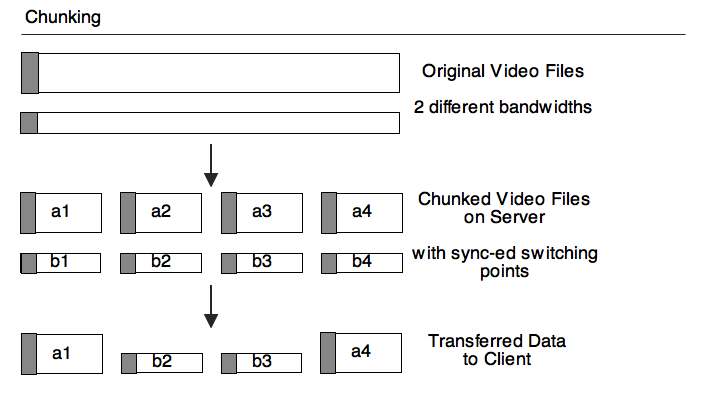
Chunking

With Chunking, the original bitrate versions are chunked into smaller full resources with defined switch-over points. This implies creation of a header on each one of the chunks and thus introduces overhead. Assuming we use 10sec chunks and 6kBytes per chunk, that results in 5kBit/sec extra overhead. After chunking the files this way, we provide a manifest file (similar to Apple’s m3u8 file, or the SMIL-based manifest file of Microsoft, or Adobe’s Flash Media Manifest file). The manifest file informs the client about the chunks and the switch-over points and the client requests those different resources at the switch-over points.

Disadvantages:

  • Header overhead on the pipe.
  • Switch-over delay for decoding the header.
  • Possible problem with TCP slowstart on new files.
  • A piece of software is necessary on server to prepare the chunked files.
  • A large amount of files to manage on the server.
  • The client has to hide the switching between full resources.

Advantages:

  • Works for live streams, where increasing amounts of chunks are written.
  • Works well with CDNs, because mid-stream switching to another server is easy.
  • Chunks can be encoded such that there is no overlap in the data necessary on switch-over.
  • May work well with Web sockets.
  • Follows the way in which proprietary solutions are doing it, so may be easy to adopt.
  • If the chunks are concatenated on the client, you get chained Ogg files (similar concept in WebM?), which are planned to be supported by Web browsers and are thus legal files.

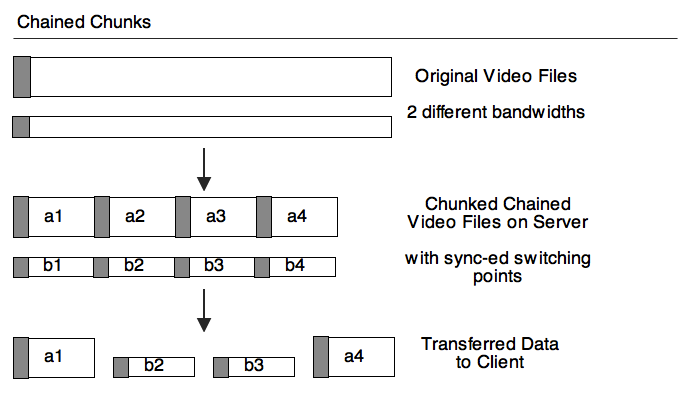
Chained Chunks

Alternatively to creating the large number of files, one could also just create the chained files. Then, the switch-over is not between different files, but between different byte ranges. The headers still have to be read and parsed. And a manifest file still has to exist, but it now points to byte ranges rather than different resources.

Advantages over Chunking:

  • No TCP-slowstart problem.
  • No large number of files on the server.

Disadvantages over Chunking:

  • Mid-stream switching to other servers is not easily possible - CDNs won’t like it.
  • Doesn’t work with Web sockets as easily.
  • New approach that vendors will have to grapple with.

Virtual Chunks

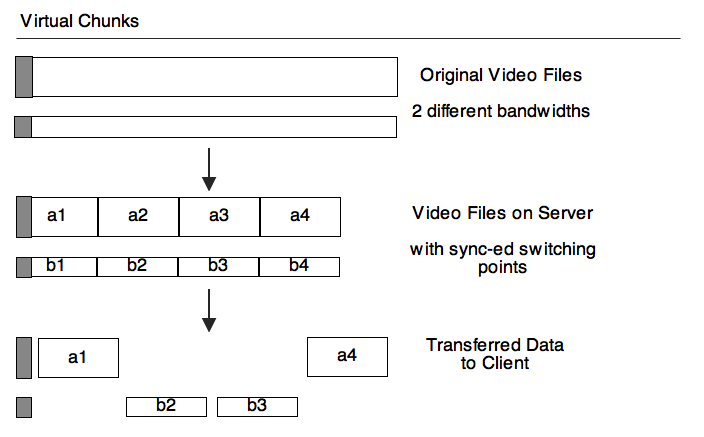
Since in Chained Chunks we are already doing byte-range requests, it is a short step towards simply dropping the repeating headers and just downloading them once at the beginning for all possible bitrate files. Then, as we seek to different positions in “the” file, the byte range of the bitrate version that makes sense to retrieve at that stage would be requested. This could even be done with media fragment URIs, through addressing with time ranges is less accurate than explicit byte ranges.

In contrast to the previous two options, this basically requires keeping n different encoding pipelines alive - one for every bitrate version. Then, the byte ranges of the chunks will be interpreted by the appropriate pipeline. The manifest now points to keyframes as switch-over points.

Advantage over Chained Chunking:

  • No header overhead.
  • No continuous re-initialisation of decoding pipelines.

Disadvantages over Chained Chunking:

  • Multiple decoding pipelines need to be maintained and byte ranges managed for each.

Unchunked Byte Ranges

We can even consider going all the way and not preparing the alternative bitrate resources for switching, i.e. not making sure that the keyframes align. This will then require the player to do the switching itself, determine when the next keyframe comes up in its current stream then seek to that position in the next stream, always making sure to go back to the last keyframe before that position and discard all data until it arrives at the same offset.

Disadvantages:

  • There will be an overlap in the timeline for download, which has to be managed from the buffering and alignment POV.
  • Overlap poses a challenge of downloading more data than necessary at exactly the time where one doesn’t have bandwidth to spare.
  • Requires seeking.
  • Messy.

Advantages:

  • No special authoring of resources on the server is needed.
  • Requires a very simple manifest file only with a list of alternative bitrate files.

Final concerns

At FOMS we weren’t able to make a final decision on how to achieve adaptive HTTP streaming for open codecs. Most agreed that moving forward with the first case would be the right thing to do, but the sheer number of files that can create is daunting and it would be nice to avoid that for users.

Other goals are to make it work in stand-alone players, which means they will need to support loading the manifest file. And finally we want to enable experimentation in the browser through JavaScript implementation, which means there needs to be an interface to provide the quality of decoding to JavaScript. Fortunately, a proposal for such a statistics API already exists. The number of received frames, the number of dropped frames, and the size of the video are the most important statistics required.

Upcoming conferences / workshops

Lots is happening in open source multimedia land in the next few months.

Check out these cool upcoming conferences / workshops / miniconfs…

September 29th and 30th, New York Open Subtitles Design Summit October 1st and 2nd, New York Open Video Conference

October 3rd and 4th, New York Foundations of Open Media Software Developer Workshop

January 24/25th, Brisbane, Australia LCA Multimedia Miniconf

Accessibility support in Ogg and liboggplay

At the recent FOMS/LCA in Wellington, New Zealand, we talked a lot about how Ogg could support accessibility. Technically, this means support for multiple text tracks (subtitles/captions), multiple audio tracks (audio descriptions parallel to main audio track), and multiple video tracks (sign language video parallel to main video track).

Creating multitrack Ogg files The creation of multitrack Ogg files is already possible using one of the muxing applications, e.g. oggz-merge. For example, I have my own little collection of multitrack Ogg files at http://annodex.net/~silvia/itext/elephants_dream/multitrack/. But then you are stranded with files that no player will play back.

Multitrack Ogg in Players As Ogg is now being used in multiple Web browsers in the new HTML5 media formats, there are in particular requirements for accessibility support for the hard-of-hearing and vision-impaired. Either multitrack Ogg needs to become more of a common case, or the association of external media files that provide synchronised accessibility data (captions, audio descriptions, sign language) to the main media file needs to become a standard in HTML5.

As it turn out, both these approaches are being considered and worked on in the W3C. Accessibility data that are audio or video tracks will in the near future have to come out of the media resource itself, but captions and other text tracks will also be available from external associated elements.

The availability of internal accessibility tracks in Ogg is a new use case - something Ogg has been ready to do, but has not gone into common usage. MPEG files on the other hand have for a long time been used with internal accessibility tracks and thus frameworks and players are in place to decode such tracks and do something sensible with them. This is not so much the case for Ogg.

For example, a current VLC build installed on Windows will display captions, because Ogg Kate support is activated. A current VLC build on any other platform, however, has Ogg Kate support deactivated in the build, so captions won’t display. This will hopefully change soon, but we have to look also beyond players and into media frameworks - in particular those that are being used by the browser vendors to provide Ogg support.

Multitrack Ogg in Browsers Hopefully gstreamer (which is what Opera uses for Ogg support) and ffmpeg (which is what Chrome uses for Ogg support) will expose all available tracks to the browser so they can expose them to the user for turning on and off. Incidentally, a multitrack media JavaScript API is in development in the W3C HTML5 Accessibility Task Force for allowing such control.

The current version of Firefox uses liboggplay for Ogg support, but liboggplay’s multitrack support has been sketchy this far. So, Viktor Gal - the liboggplay maintainer - and I sat down at FOMS/LCA to discuss this and Viktor developed some patches to make the demo player in the liboggplay package, the glut-player, support the accessibility use cases.

I applied Viktor’s patch to my local copy of liboggplay and I am very excited to show you the screencast of glut-player playing back a video file with an audio description track and an English caption track all in sync:

elephants_dream_with_audiodescriptions_and_captions

Further developments There are still important questions open: for example, how will a player know that an audio description track is to be played together with the main audio track, but a dub track (e.g. a German dub for an English video) is to be played as an alternative. Such metadata for the tracks is something that Ogg is still missing, but that Ogg can be extended with fairly easily through the use of the Skeleton track. It is something the Xiph community is now working on.

Summary This is great progress towards accessibility support in Ogg and therefore in Web browsers. And there is more to come soon.

Audio Track Accessibility for HTML5

I have talked a lot about synchronising multiple tracks of audio and video content recently. The reason was mainly that I foresee a need for more than two parallel audio and video tracks, such as audio descriptions for the vision-impaired or dub tracks for internationalisation, as well as sign language tracks for the hard-of-hearing.

It is almost impossible to introduce a good scheme to deliver the right video composition to a target audience. Common people will prefer bare a/v, vision-impaired would probably prefer only audio plus audio descriptions (but will probably take the video), and the hard-of-hearing will prefer video plus captions and possibly a sign language track . While it is possible to dynamically create files that contain such tracks on a server and then deliver the right composition, implementation of such a server method has not been very successful in the last years and it would likely take many years to roll out such new infrastructure.

So, the only other option we have is to synchronise completely separate media resource together as they are selected by the audience.

It is this need that this HTML5 accessibility demo is about: Check out the demo of multiple media resource synchronisation.

I created a Ogg video with only a video track (10m53s750). Then I created an audio track that is the original English audio track (10m53s696). Then I used a Spanish dub track that I found through BlenderNation as an alternative audio track (10m58s337). Lastly, I created an audio description track in the original language (10m53s706). This creates a video track with three optional audio tracks.

I took away all native controls from these elements when using the HTML5 audio and video tag and ran my own stop/play and seeking approaches, which handled all media elements in one go.

I was mostly interested in the quality of this experience. Would the different media files stay mostly in sync? They are normally decoded in different threads, so how big would the drift be?

The resulting page is the basis for such experiments with synchronisation.

The page prints the current playback position in all of the media files at a constant interval of 500ms. Note that when you pause and then play again, I am re-synching the audio tracks with the video track, but not when you just let the files play through.

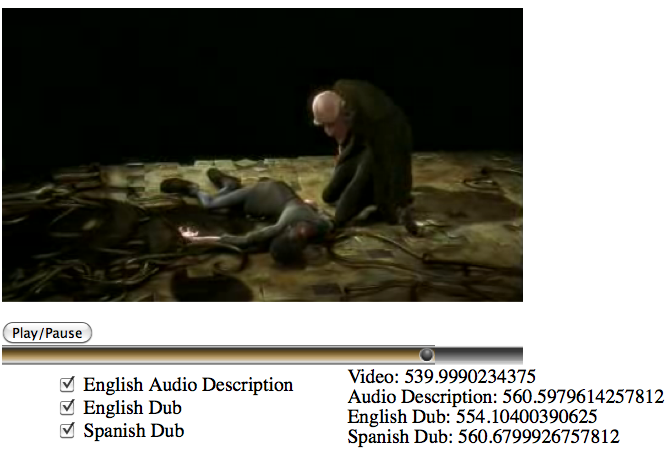
I have let the files play through on my rather busy Macbook and have achieved the following interesting drift over the course of about 9 minutes:

Drift between multiple parallel played media elements

You will see that the video was the slowest, only doing roughly 540s, while the Spanish dub did 560s in the same time.

To fix such drifts, you can always include regular re-synchronisation points into the video playback. For example, you could set a timeout on the playback to re-sync every 500ms. Within such a short time, it is almost impossible to notice a drift. Don’t re-load the video, because it will lead to visual artifacts. But do use the video’s currentTime to re-set the others. (UPDATE: Actually, it depends on your situation, which track is the best choice as the main timeline. See also comments below.)

It is a workable way of associating random numbers of media tracks with videos, in particular in situations where the creation of merged files cannot easily be included in a workflow.

Video Streaming from Linux.conf.au

You probably heard it already: Linux.conf.au is live streaming its video in a Microsoft proprietary format.

Fortunately, there is now a re-broadcast that you can get in an open format from http://stream.v2v.cc:8000/ . It comes from a server in Europe, but relies on transcoding here in New Zealand, so it may not be completely reliable.

UPDATE: A second server is now also available from the US at http://repeater.xiph.org:8000/.

Today, the down under open source / Linux conference linux.conf.au in Wellington started with the announcement that every talk and mini-conf will be live streamed to the Internet and later published online. That’s an awesome achievement!

However, minutes after the announcement, I was very disappointed to find out that the streams are actually provided in a proprietary format and through a proprietary streaming protocol: a Microsoft streaming service that provides Windows media streams.

Why stream an open source conference in a proprietary format with proprietary software? If we cannot use our own technologies for our own conferences, how will we get the rest of the world to use them?

I must say, I am personally embarrassed, because I was part of several audio/video teams of previous LCAs that have managed to record and stream content in open formats and with open media software. I would have helped get this going, but wasn’t aware of the situation.

I am also the main organiser of the FOMS Workshop (Foundations of Open Media Software) that ran the week before LCA and brought some of the core programmers in open media software into Wellington, most of which are also attending LCA. We have the brains here and should be able to get this going.

Fortunately, the published content will be made available in Ogg Theora/Vorbis. So, it’s only the publicly available stream that I am concerned about.

Speaking with the organisers, I can somewhat understand how this came to be. They took the “easy” way of delegating the video work to an external company. Even though this company is an expert in open source and networking, their media streaming customers are all using Flash or Windows media software, which are current de-facto standards and provide extra features such as DRM. It seems apart from linux.conf.au there were no requests on them for streaming Ogg Theora/Vorbis yet. Their existing infrastructure includes CDN distribution and CDN providers certainly typically don’t provide Ogg Theora/Vorbis support or Icecast streaming.

So, this is actually a problem founded in setting up streaming through a professional service rather than through the community. The way in which this was set up at other events was to get together a group of volunteers that provided streaming reflectors for free. In this way, a community-created CDN is built that can deal with the streams. That there are no professional CDN providers available yet that provide Icecast support is a sign that there is a gap in the market.

But phear not - a few of the FOMS folk got together to fix the situation.

It involved setting up Icecast streams for each room’s video stream. Since there is no access to the raw video stream, there is a need to transcode the video from proprietary codecs to the open Ogg Theora/Vorbis format.

To do this legally, a purchase of the codec libraries from Fluendo was necessary, which cost a whopping EURO 28 and covers all the necessary patent licenses. The glue to get the videos from mms to icecast streams is a GStreamer pipeline which I leave others to talk about.

Now, we have all the streams from the conference available as Ogg Theora/Video streams, we can also publish them in HTML5 video elements. Check out this Web page which has all the video streams together on a single page. Note that the connections may be a bit dodgy and some drop-outs may occur.

Further, let me recommend the Multimedia Miniconf at linux.conf.au, which will take place tomorrow, Tuesday 19th January. The Miniconf has decided to add a talk about “How to stream you conference with open codecs” to help educate any potential future conference organisers and point out the software that helps solve these issues.

UPDATE: I should have stated that I didn’t actually do any of the technical work: it was all done by Ralph Giles, Jan Gerber, and Jan Schmidt.

FOMS and LCA Multimedia Miniconf

If you haven’t proposed a presentation yet, got ahead and register yourself for:

FOMS (Foundations of Open Media Software workshop) at http://www.foms-workshop.org/foms2010/pmwiki.php/Main/CFP

LCA Multimedia Miniconf at http://www.annodex.org/events/lca2010_mmm/pmwiki.php/Main/CallForP

It’s already November and there’s only Christmas between now and the conferences!

I’m personally hoping for many discussions about HTML5

But there are heaps of other topics to discuss and anyone doing any work with open media software will find a fruitful discussions at FOMS.

First experiments with itext

My accessibility work for Mozilla is showing first results.

I have now implemented a demo for the previously proposed element. During the development process, the specification became more concrete.

I’m sure you’re keen to check out the demo.

Please note the following features of the demo:

  • It experiments with four different types of time-aligned text: subtitles, captions, chapters, and textual audio annotations.
  • It extends the video controls by a menu button for the time-aligned text tracks. This enables the user to switch between different languages for the different tracks.
  • The textual audio annotations are mapped into an aria-live activated div element, such that they are indeed read out by screen-readers; this div sits behind the video, invisible to everyone else.
  • The chapters are displayed as text on top of the video.
  • The subtitles and captions are displayed as overlays at the bottom of the video.
  • The display styles and positions are supposed to be default display mechanisms for these kinds of tracks, that could be overwritten by the stylesheet of a Web developer, who intends to place the text elsewhere on screen.

In order to “hear” the textual audio annotations work, you will need to install a screen reader such as JAWS, NVDA, or the firevox plugin on the Mac.

As far as I am aware, this is the first demo of HTML5 video accessibility that includes support for the vision-impaired, hearing-impaired, and also for foreign language speakers.

There have been initial discussions about this proposal, the results of which are captured in the wiki page. I expect a lot more heated discussion will happen on the WHATWG mailing list when I post it soon. I am well aware that probably most of the javascript API will need to be changed, and also some of the HTML.

Also please note that there are some bugs still left on the software, which should not inhibit the discussion at this stage. We will definitely develop a newer and better version.

I am particularly proud that I was able to make this work in the experimental builds of Opera and Chrome, as well as in Safari with XiphQT installed, and of course in Firefox 3.5.

Screenshot of first itext video player Screenshot of first itext video player experiment
YouTube Ogg Theora+Vorbis & H.263/H.264 comparison

On Jun 13th 2009 Chris DiBona of Google claimed on the WhatWG mailing list:

“If [youtube] were to switch to theora and maintain even a semblance of the current youtube quality it would take up most available bandwidth across the Internet.”

Everyone who has ever encoded a Ogg Theora/Vorbis file and in parallel encoded one with another codec will have to immediately protest. It is sad that even the best people fall for FUD spread by the un-enlightened or the ones who have their own agenda.

Fortunately, Gregory Maxwell from Wikipedia came to the rescue and did an actual “YouTube / Ogg/Theora comparison”. It’s a good read and a comparison on one video. He has put his instructions there, so anyone can repeat it for themselves. You will have to start with a pretty good quality video though to see such differences.

Sites with Ogg in HTML5 video tag

Yesterday, somebody mentioned that the HTML5 video tag with Ogg Theora/Vorbis can be played back in Safari if you have XiphQT installed (btw: the 0.1.9 release of XiphQT is upcoming). So, today I thought I should give it a quick test. It indeed works straight through the QuickTime framework, so the player looks like a QuickTime player. So, by now, Firefox 3.5, Chrome, Safari with XiphQT, and experimental builds of Opera support Ogg Theora/Vorbis inside the HTML5 video tag. Now we just need somebody to write some ActiveX controls for the Xiph DirectShow Filters and it might even work in IE.

While doing my testing, I needed to go to some sites that actually use Ogg Theora/Vorbis in HTML5 video tags. Here is a list that I came up with in no particular order:

I’m sure there’s a lot more out there - feel free to post links in the comments.

Firefox plugin to encode Ogg video

Michael Dale just posted this to theora-dev. Go to one of the given URLs to install the Firefox plugin that lets you transcode video to Ogg using your Web browser.

Firefogg is developed by Jan Gerber and lives at http://www.firefogg.org/. There is a javascript API available so you can make use of Firefogg in your own Website project to allow people to upload any video and transcode it to Ogg on the fly.

Enjoy!

On Fri, Jun 5, 2009 at 7:08 AM, Michael Dale wrote: > I mentioned it in the #theora channel a few days ago but here it is with > a more permanent url: > > http://www.firefogg.org/make/advanced.html > & > http://www.firefogg.org/make/ > > These will be simple links you can send people so that they can encode > source footage to a local ogg video file with the latest and greatest > ogg encoders (presently thusnelda and vorbis). Updates to thusnelda and > possible other free codecs will be pushed out via firefogg updates ;) > > Pass along any feedback if things break or what not. > > I am also doing testing with “embed” these encoder interface. For those > familiar with jQuery: an example to rewrite all your file inputs with > firefogg enhanced inputs: $(“input:[type=‘file’]“).firefogg() … Feel > free to expeirment based on those examples. The form rewrite has mostly > only been tested in the mediaWiki context: > http://sandbox.kaltura.com/testwiki/index.php/Special:Upload > but with minor hacking should work elsewhere :) > > enjoy > —michael > > _______________________________________________ > theora mailing list > theora@xiph.org > http://lists.xiph.org/mailman/listinfo/theora >

FOMS 2009: video introductions available

In January this year we had the third Foundations of Open Media software workshop for developers. The focus this year was on legal issues around codecs, Xiph and Web video (HTML5 video and video servers), authoring/editing software, and accessibility. Check out the complete set of areas of concern and community goals that we decided upon.

As every year, at the beginning of the workshop every participant provided a 5 min introduction about their field of speciality and the current challenges. These are video recorded and shared with the community.

The videos and accompanying slides have been available for about 2 months now, but I haven’t gotten around to blogging about it - apologies everyone! So, here are your star videos in reverse alphabetic order published using open source video software only:

Enjoy!

FFMPEG release

Quick Press: the awesome guys from FFmpeg have made an official release this week. The days of pain for compiling and packaging FFmpeg have come to an end. FFmpeg is being used in many Web video sites to provide backend transcoding - FAIK that includes YouTube. I use FFmpeg for all my transcoding needs and it has never let me down. Open media software to the win!

Progress on captions for HTML5 video

Paul Rouget this week published another example implementation for using srt with HTML5 video with a javascript library. This is at least the fourth javascript implementation that I know of for attaching srt subtitles to the video element.

It is great to see such a huge need for this. At the same time I am also worried about the amount of incompatible implementations of this feature. It will inhibit search engines from realising which text relates to and describes a particular video. It will also inhibit accessibility technology such as screen readers or braille devices from realising there is text that would be necessary to be rendered.

A standard means of associating srt (or other format) subtitle files with the video tag is really necessary. So, where are we at with this?

Recently, Greg Millam from Google posted a proposal to WHATWG, that shares a lot of elements with the proposal that has been previously discussed between Mozilla, Xiph, and Opera, the current state of which is summarised in the Mozilla wiki. No implementation into a Browser has been made yet, but initial implementations in javascript exist. I think that we will ultimately come out with a harmonised solution between the browser vendors. It just needs implementation work and continuous improvement.

At the same time, in-band captions that come multiplexed within the Ogg file are also being progressed. At Xiph we are now focusing on using Ogg Kate for these purposes - it really don’t make much sense to invent another codec when Ogg Kate is already so close to solving most problems. So, between the developer of Ogg Kate and myself, we are preparing a Google Summer of Code project that should see a implementation for Firefox 3.1 that is capable of extracting the text from an Ogg file that has a Kate track and displaying that track as though it was a srt file. If you are interested, shoot me an email!

UPDATE: Firefox 3.1 is apparently now called Firefox 3.5 - sorry guys. :-)

ANOTHER UPDATE: My post seemed to imply that Firefox 3.5 will have Ogg Kate support. This is not the case. There is a patch for Firefox and liboggplay to provide Ogg Kate support into Firefox and this patch will be the basis of the Summer of Code project. The student will then work mostly on implementing a comprehensive javascript library to display Ogg Kate encoded time-aligned text (read: captions, Karaoke etc) in the Web browser. This is a proof-of-concept and a first step towards standardising the handling of time-aligned text in Web browsers that suppor the HTML5 video tag.

FOMS 2009 Awesomeness

I am a slacker, I know - sorry. FOMS happened almost 4 weeks ago and I have neither blogged about it nor uploaded the videos.

So, you will have to take my word for it for the moment: it was a totally awesome and effective workshop that led to a lot of work being started during LCA and having an impact far beyond FOMS.

Every year, the discussions we are having at FOMS are captured in so-called community goals. These are activities that we see as top priorities for open media software to be addressed to improve its use and uptake.

You can read up on our 2009 community goals here in detail. They fall into the following 10 sections:

  1. Patent and legal issues around codecs
  2. Ogg in Firefox: liboggplay
  3. Authoring tools for open media codecs
  4. Server Technology for open media
  5. Time-aligned text and accessibility challenges
  6. FFmpeg challenges
  7. GStreamer challenges
  8. Dirac challenges
  9. Jack challenges
  10. OpenMAX challenges

In this post, I’d just like to point out some cool activities that have already emerged since FOMS.

I’ve already written on the patents issue and how OpenMediaNow will hopefully be able to make a difference here.

Liboggplay provides a simple API to decoding and playback of Ogg codecs and is therefore in use for baseline Ogg Theora support in Firefox 3.1. A bunch of bugs were found around it and the opportunity of having Shane Stephens, its original developer, together with Viktor Gal, its new maintainer, in the same room made for a whole lot of bug fixes. The $100K Mozilla grant towards the work of Xiph developers that was announced at FOMS will further help to mature this and other Xiph software. Conrad Parker, Viktor Gal, and Timothy Terriberry, the Xiph developers that will cut code under this grant, were incidentally all present at FOMS.

The discussion about the need for authoring software support for open media codecs is always a difficult one. We all know that it is important to have usable and graphically attractive authoring tools in order to get adoption. However, looking at reality, it is really difficult to design and implement a GUI authoring tool such as a video editor to a competitive quality. In other areas, it has also taken quite some time to gain good authoring software such as e.g. the Gimp or Inkscape. Plus there is the additional need to make it cross-platform. With video, often the underlying editing functionality is missing from media frameworks. Ed Hervey explained how he extended gstreamer with the required subroutines and included them into the gstreamer python plugin, so now he will be able to focus on user interface work in PiTiVi rather than the underlying video editing functionality.

The authoring discussion smoothly led over to the server technology discussion. Robin Garvin explained how he implemented a server-side video editor through EDLs. Michael Dale showed us the latest version of his video editor in the Mediawiki Metavid plugin. And Jan Gerber showed us the Firefogg Firefox plugin for transcoding to Ogg. Web-based tools are certainly the future of video authoring and will make a huge difference in favor of Ogg.

Then there was the accessibility discussions. During FOMS I was in the process of writing up my final report on the Mozilla video accessibility project and it was really important to get input from the FOMS community - in particular from Charles McCathyNevile from Opera, Michael Dale from Metavid/Wikipedia/Archive.org and Jan Gerber. In the end we basically agreed that a lot of work still needs to be done and that a standard way of providing srt support into HTML5 through Ogg, but also out-of-band will be a great step forward, though by far not the final one.

The remaining topics were focused discussions on how to improve support, uptake or functionality of specific tools. Peter Ross took FOMS concerns about ffmpeg to the ffmpeg community and it seems there will be some changes, in particular an upcoming ffmpeg release. Ed Hervey took home a request for new API functions for gstreamer. Anuradha Suraparaju talked with Jan Gerber about support of Dirac in firefogg and with Viktor Gal about support in liboggplay. Further, the idea of libfisheye was born to have a similar abstraction library for Ogg video codecs as libfishsound is for Ogg audio codecs.

As can be seen, there are already some awesome outcomes from FOMS 2009. We are looking forward to a FOMS 2010 in Wellington, New Zealand!

News from the open media world

Today, there were so many news that I can only summarise them in a short post.

The guys from Collabora have announced that they are going to support the development of PiTiVi - one of the best open source video editors around. They are even looking to hire people to help Christian Schaller, the author of PiTiVi. The plan is to have a feature-rich video editor ready by April next year that is comparable in quality to basic proprietary video editors.

The BBC Dirac team have today announced a ffmpeg2dirac software package, which is built along the same lines as the commonly used ffmpeg2theora and of course transcodes any media stream to Ogg Dirac/Vorbis. With Ogg Dirac/Vorbis playback already available in vlc and mplayer, this covers the much needed creation side of Ogg Dirac/Vorbis files. Dirac is an open source, non-patent-encumbered video codec developed by the BBC. It creates higher quality video than Theora at comparable bitrates.

The FOMS - Foundations of Open Media Software hacker workshop for open media software announced today the current list of confirmed participants for the January Workshop. It seems that this year we have a big focus on open video codecs, on browser support of media, on open Flash software, and on media frameworks. It is still possible to take part in the workshop - check out the CFP page.

Finally an important security message: Mozilla has decided to put a security measure around the HTML5 audio and video elements that will stop them from being exploited by cross-site scripting exploits. Chris Double explains the changes that are necessary to your setup to enable your published audio or video to be displayed on domains that are different to the domain on which these files are hosted.

FOMS submission deadline extended

The Foundations of Open Media Software workshop has just extended its deadline for submission of registrations requests with travel sponsorship.

FOMS addresses hot topics - such as the new

In previous years, FOMS has stimulated heated technical discussions and amazing new developments in open media software, such as the creation of libsydneyaudio, the uptake of liboggplay, the creation of Xiph ROE, or the creation of the new Ogg CELT codec.

Video proceedings of last years’ workshops are here. There are also community goals that were set in 2008 and 2007 and provide ongoing challenges.

You should definitely attend, if you are an open media software hacker. This is a chance to get to know others in the community personally and clear up those long-standing issues that need a face-to-face to get solved. Also, it’s a great social event not to be missed. As a bonus, you can spend the week after FOMS at LCA, the world-famous Australian Linux hackers conference, and deepen your relationships in the community. Come and join in the fun in January 2009, Summer in Hobart, Tasmania.

Seeking a maintainer for liboggplay

liboggplay is a library that vastly simplifies the decoding and playback of Ogg encapsulated audio-visual content for programmers. It abstracts away from the complexity of libogg’s encapsulation pages, codec packets, and encoded data, giving the programmer the freedom to work with audio-visual streams, video frames, and audio samples. It does everything apart from the actual display of audio and video and has thus been selected as the thinnest library to provide support for Ogg Theora/Vorbis in Firefox’s new HTML5 .

Shane Stephens, now with Google, implemented most of liboggplay while working at CSIRO on the Annodex project. Chris Double picked up liboggplay for Mozilla/Firefox, where it got committed to trunk only this week. Many others have and continue to provide patches. And finally, yesterday, I made an actual first tarball release of liboggplay.

There is only one little hick-up: liboggplay doesn’t actually have a maintainer. So, we are now looking to find somebody who is highly enthusiastic about open media codecs, has experience in C programming, can compile and test liboggplay on all major operating systems (probably set it up on a build farm) and has enough time to react swiftly to the need of bug fixes. We don’t want people’s Firefoxes to choke on Ogg content, but rather amaze them about how easy to handle and nicely integrated Ogg works on the Web.

One of the big next challenges for liboggplay is the implementation of support for Ogg Dirac - the BBC’s wavelet-based video codec. Mozilla, would be very keen to get Dirac support into liboggplay and thus diversify the open codecs supported in Firefox.

If you want to become the new maintainer for liboggplay, or want to implement Ogg Dirac support into liboggplay, or do both, get in touch with me and we’ll get you set up.

Native Ogg Theora support in Firefox

What a day for great news!

Chris Blizzard and Chris Double of Mozilla have just announced that native Ogg Theora and Vorbis support is now available in the trunk of Firefox’s codebase. Compiles of that codebase have the support enabled by default, which means that very soon now any Firefox that gets installed on any platform will come with built-in Ogg Theora/Vorbis support out of the box.

This is exciting in more than one way.

First of all: it is a browser implementation of the new HTML5 video tag currently in the process of standardisation. Opera is the only other browser that has support for the video tag also using Ogg Theora as the baseline codec, but Opera’s support is in an experimental branch, while Firefox will be the first to have native support.

The choice to include Ogg Theora natively is a huge step forward on Mozilla’s behalf considering the submarine patent debate that has been raging around this codec ever since it was removed from the HTML5 specification as baseline codec. So, maybe the Mozilla lawyers believe the risk of this threat is negligible and if they have, other browser vendors may follow.

This is a big day for open media technology and a big day for the future of video on the Web.

It is important because the availability of free and unencumbered video and audio codecs that are natively supported on the Web will make a huge difference in progressing the capabilities of video on the Web. As an example, look at the efforts of Annodex, where we are creating video webs through a video format with embedded hyperlinks and annotations. To make this feasible, you need a standard and open format for the time-aligned hyperlinks and annotations, which will only work with a flexible open video format. This is just an example: open captioning and karaoke formats, open overlay formats and many other extensions to video formats will now be feasible. The golden age of online video is starting.

Michael Dale’s metavid project is giving us a taste of this future. Video can be searched on time-aligned annotations and only the relevant video segment will be retrieved. Video segments can be addressed by temporal hyperlinks and recombined easily into new mash-ups simply through the creation of a list of temporal hyperlinks. How powerful this will be when we do it across sites! This takes video into a completely new dimension.

Now, let’s step back again from the future to the current exciting news. I am particularly proud of the input that Annodex people have made to this development - code from people like Conrad Parker, Andre Pang, Zen Kavanagh, Shane Stephens, and many others.

Chris Double from Mozilla has been implementing the Firefox Ogg Theora support for more than a year and is using Shane Stephens’ liboggplay library, which was originally developed by CSIRO and is in the code repository of the Annodex Association. liboggplay requires libraries from Xiph.org (libogg, libvorbis, libtheora) and from Annodex (liboggz and libfishsound) to work. All of this has to work across operating system platforms.

It is an enormous achievement and I congratulate the open media technology community on this big success.

to_bool rails plugin

In our rail application we do a lot of string conversions to other data types, including Boolean. Unfortunately, ruby does not provide a conversion method to_bool (which I find rather strange, to be honest).

Based a blog post by Chris Roos in October 2006, we developed a rails plugin that enables the “to_bool” conversion.

“to_bool” works on the strings “true” and “false” and any capitalisation of these, and on numbers, as well as on nil. Other strings raise an ArgumentError.

Examples are as follows:

'true'.to_bool #-> true 'TrUe'.to_bool #-> true true.to_bool #-> true 1.to_bool #-> true 5.to_bool #-> true -9.to_bool #-> true nil.to_bool #-> false 'false'.to_bool #-> false 'FaLsE'.to_bool #-> false false.to_bool #-> false 0.to_bool #-> false You can find the plugin here as a tarball. To install it, simply decompress the to_bool directory into your vendor/plugins directory.

FOMS Workshop - Call for Participation is OPEN

The Foundations for Open Media Software workshop will take place in January 2009 for the third time before LCA. Yay!! This year in beautiful Tasmania!

At 17:33pm on Wed 11th June on irc #foms, the Call for Participation was declared open.

If you have any engagement with the development of open standards and open source software in the digital media space, consider attending. To attend, all we ask for is an email to the committee. Really simple!

We will have travel sponsorship for some key people and if the last two years are anything to go by, we will see some serious improvements to open media technology coming out of FOMS - an event that always stretches over the whole duration of LCA.

I can’t wait till Christmas is over…

Metadata and Ogg

I am really excited about the huge progress we made at FOMS with metadata and Ogg. The metadata specifications are actually not Ogg-specific - only their mapping into Ogg is. Here are the things that I expect will make for a very structured and sensible distributed handling of metadata on the Web.

At FOMS, we started improving CMML and are now specifying the next version of CMML. CMML is a timed text description language that can easily be multiplexed alongside audio or video data. It is very flexible with its fields and satisfies needs for hypermedia, captions, annotations and other time-aligned text. We took out the Ogg dependencies and it can now be used in any media container format. The specification is now also in an XML schema rather than a DTD, which enables us to reuse modules from XHTML and make it generally more extensible.

We introduced ROE, a description language (or a “manifest”) for multitrack media files. It describes media tracks and their dependencies and thus goes much further than the old stream and import elements in CMML, that now have been deprecated.

ROE can be used to author multitrack media files - in the Ogg case to author Ogg files with a Skeleton track and multiple media tracks. We are in the process of extending Skeleton to incorporate the description of dependencies between logical bitstreams. To complete this, we will be creating a description of how to map ROE into Ogg/Skeleton and vice versa.

ROE can also be used to negotiate with a Web client what media streams to send from the complete manifest that is available on the server. For example, a Web client could request the German sound track with a movie rather than the default English one, and to add English subtitles. This requires a small protocol for negotiation, which can easily be build using Web infrastructure. We are introducing some new HTTP request/response parameters and specific URLs, such as e.g. http://example.com/movie.ogg?track=V1,A2,TT2.

The set of ROE, Skeleton, CMML, and the HTTP and URI specifications will enable a very structured means of interacting with metadata-rich video on the Web. It will be distributed and integrated into the Web infrastructure, much like the Annodex set of technologies already is today.

Since I am also a business owner aside of being an open media enthusiast, let me add that I expect it to have a huge impact on online business around audio and video, enabling business processes and business models that are not possible today. Watch this space!

The greatest gathering of open media sw developers

When I started organising the first FOMS (Foundations of open media software developers workshop) in 2007, I did it because I saw a need to have media hackers get together in a room and discuss stuff in person. Email, irc, svn, bugzilla and wikis only get you a certain distance for collaboration. But no distance communication tool can replace the energy and creative spirit that is created through an in-person meeting and the ability to have a beer together in the evening. Discussions are more intense, impossibilities are identified faster, progress is amazing - and the energy will last and have an impact on the community for months to come after the event.

FOMS 2007 was great in that respect, because some 25 hackers got to know each other for the first time, friendships were formed, trust was built and new ideas (speaking: new code) was created. It was awesome and gave me the motivation to go and organise FOMS 2008. At this point let me express my gratitude to the organising committees of both FOMS 2007 and FOMS 2008 for the support they have given me to organise both workshops and hope they will help again next year in Tasmania.

So then FOMS 2008 took place and what can I say!? It totally blew me away. For me it was a much better experience than the year before because I didn’t also organise the video recordings at LCA. I was therefore more relaxed, got involved in design discussions, and was able to sit down during the week after FOMS at LCA and actually interact with people. On a side note here: Thanks so much to Donna Benjamin, the main organiser of LCA 2008, for getting the FOMS participants a room to ourselves where we were able to gather and get an awesome whole lot of work done.

Nearly the whole Xiph community was at FOMS and issues that have been brewing for years were tabled and discussed. A large number of audio hackers were there, too, and the issue of a standard sound APIs got some heated discussion. There’s a press release and the proceedings of the FOMS discussions up on the FOMS 2008 website, where you can make yourself a complete picture of all the issues that were discussed.

In addition to FOMS, Conrad Parker and I had also organised a Multimedia Miniconf at LCA. It was a great place to communicate some of the outcomes of FOMS and to present some of the latest developments in open media software in the Linux community. Video proceedings are available on the site.

Overall I must say that January has become the highlight of my year in open media software.

FOMS 2008 support by Mozilla Foundation

It is awesome to see FOMS - the Open Media Software developer workshop we ran for the first time this year - turning into a major audio and video developer event for Linux. FOMS 2008 will be in Mel8ourne in January and will focus on audio on Linux (in particular libsydneyaudio) and on native Firefox support for Ogg Theora (in particular liboggplay). Because of the latter, FOMS has attracted sponsorship by the Mozilla Foundation. This sponsorship is very welcome since most of the relevant developers come from overseas and are not part of large organisations that could afford to pay the expense. Check out the current list of participants on the site - it will be another milestone event for open media! And … thanks Mozilla Foundation!

LCA Multimedia Miniconf

The organisers of LCA have found another slot for a miniconf and ours is it! Yay!! We shall have an audio/video miniconf at LCA! This is particularly important since we will bring to Australia a large number of key open media application developers for FOMS. These guys will also be able to provide deep insight and understanding during talks provided to the more general LCA audience. Expect some awesome media talks at LCA!!

Foundations of Open Media Software 2008

Good news, everybody: We are repeating the successful open audio/video developer workshop in 2008 - the CFP for FOMS 2008 is now public!

FOMS (Foundations of Open Media Software) will again take place in the week ahead of LCA (Australian’s Annual Conference for Linux and Open Source Developers) - whose CFP is also out. Get started submitting abstracts because LCA’s published deadline for submissions is 20th July.

To complete the pack, LCA MultiMedia is an a/v miniconf for LCA in planning, such that LCA attendees will also have a chance to hear the latest and most exciting news from the developer bench.

FOMS 2007 was a huge success. It brought face-to-face some of the core Linux audio and video developers, which promptly started attacking some of the key obstacles for an improved audio/video experience on Linux and with open media software in general.

Jean-Marc Valin (author of speex), Lennart Poettering (author of PulseAudio) a group of programmers from Nokia and a few others started designing libsydneyaudio - a library which is deemed to solve the mess of audio on Linux in a means that is also cross-platform compatible.

Also, a community started building around liboggplay, a library designed to allow drop-in playback of Xiph.Org media in an application. libogg is currently being prepared for a submission to Mozilla to provide native Ogg (and Annodex) support inside Firefox as part of the new HTML5 . Then, Ogg Theora, Vorbis & Speex will play out of the box on a newly installed Firefox without requiring to install any further helpers software.

These are just the highlights from FOMS 2007 - expect more exiting news from FOMS 2008!

FOMS - the birth of a new open media forum

The first FOMS (Foundations of Open Media Software) workshop is over and it was an overwhelming success - more than ever expected! And wow - we have videos of it, too - thanks to Ralph Giles and Thomas Vander Stichele.

The goal of FOMS was to bring a diverse group of people from all around the planet who are all working on open media software together for the first time so they could get to know each other, exchange ideas, and generally address the things that annoy us all with open media technologies.

Strategically placing FOMS in the week before LCA was a great idea: not only would some of the developers attend LCA anyway and thus would not need to use up extra travel time, but also would LCA provide opportunities for the newly forged relationships to flourish and create code.

A new forum for discussion was created and since the community has committed to achieving a set of community goals, we expect it will have some basic effect on the usability of open media software over time.

And yes … all participants are up for a repetition of FOMS - possibly as a precursor to other FLOSS conferences overseas, but at a minimum again at next year’s LCA in Melbourne. Let’s rock it!

Why we need a open media developer conference

Have you ever been stuck with a video file that does not play in any of your video players or the Web Browser? It happens frequently because the media technology landscape is still a very fragmented one where a lot of energy is put into the creation of proprietary compression technologies. But the consumer is unwilling to follow every new encoding format and to pay for codecs which he/she may only need for this one file.

Just as the use of free and unencumbered text encoding formats (ASCII, UTF-8) is a prerequisite to the development of novel applications and an enabler of email, the Web, and many other common applications, free video and audio formats enable the creation of novel applications with media.

Free and unencumbered codecs are starting to become mature. The codecs from Xiph.org cover audio (Vorbis, Speex, FLAC) and video (Theora) are readily available and supported on many platforms. The BBC’s next-generation video codec called Dirac is still in the labs, but is one of the few cutting-edge codecs built on Wevelets, a novel transform that promises higher compression rates with less artefacts - and it is free and unencumbered.

However, the availability of codecs is not all that matters. Audio-visual applications that make use of these codecs need to be developed, too. Applications such as video editors, desktop audio/video players, Webbrowser embedded players, and streaming technology are fundamental to enable the full production-to-publishing chain. And then there are the higher-level applications such as playlist and collections manager (iTunes-like), video Web hosting, video search, or Internet video conferencing applications which provide the real value to people.

Foundations of Open Media Software is the first conference ever to bring together the architects of open media software systems from around the world to address technical issues and further the development of a open media ecology where the focus is on the development of new high-value applications rather than a tiring and unproductive competition of formats.

FOMS furthers the development of media technology on Linux, addresses support of open media codecs across platforms, and works towards the creation of an ecosystem of rich media applications.

The principles of creative commons content around a free exchange of ideas through digital media requires adequate licenses to be attached to media files, which in turn will only work in an environment where the media formats of such content is unrestricted and unencumbered, too.

Foundations of Open Media Software takes place in Sydney, Australia 11th-12th January 2007. Since it is a conference organised by developers for developers, donations are highly welcome. There are also some spaces for professional delegates available still. Details are at http://www.annodex.org/events/foms2007/ .

FOMS: Foundations of Open Media Software

From Thursday 11 - Friday 12 January 2007 we will have some of the world’s top open media software developers gather in Sydney at a workshop titled “Foundations of Open Media Software” (FOMS).

The workshop takes place in the week before linux.conf.au (LCA), thus enabling developers to cross-pollinate with the developers and attendants of LCA. FOMS is supported by LCA with venue and other logistics.

I’m happy to be one of the core organisers of this workshop and very excited about the vibe that this will bring to the open media software developer community. FOMS creates a venue for a community that has thus far not had its own gathering place.

In January: Sydney will rock the FOSS world doubly!!