ginger's thoughts

Silvia's blog

Category: Vquence

My first released WordPress plugin

A screenshot of the gallery that the external video plugin creates

I’m pretty proud of this, which is why I’m dedicating a short blog post to it: today, John and I released my first WordPress plugin as open source to the WordPress plugins site.

It’s got the boring name “External Videos” and builds a bridge between your WordPress instance and videos of channels on a video hosting site - currently supported are YouTube, Vimeo, and DotSub.

It does this by using a brand-new feature to be introduced in WordPress 3: custom post types.

Check out the screenshots on the plugins page to see more - I’m unfortunately not yet running this Website with WordPress 3, so am not yet using this plugin’s features.

In the admin interface of WordPress, you enter the video channels that you want to pull videos from. Then it goes and pulls the videos with their metadata from these sites and creates video posts for them. That pulling is done once a day to update with new posts. The videos can be looked at in the admin interface under a separate video post section. They can be linked to WordPress posts and pages where the video may be discussed in context.

The video posts can be exposed on the WordPress site through a gallery, which is created by a short code, that can be added to any WordPress page. The gallery of thumbnails clicks through to an overlay with each video and its metadata as well as a link to the related WordPress post.

You can also add a widget to the side bar of the WordPress site with links to the most recent videos.

There are many more features that I want to develop for this plugin. I’d of course like to move it to HTML5 video instead of Adobe Flash. But for now I am happy with it.

I’d like to say thank you to John Ferlito, who helped with some of the coding, to Jeff Waugh for suggesting that it would best be developed using the new post types feature, and to Senator Kate Lundy and Pia Waugh at her office, who funded a part of the development. I am hoping they will find it useful to give their awesome collection of videos better exposure.

NOTE: you can post your issues with this plugin now to the wordpress forum at http://wordpress.org/tags/external-videos

Google video: 2.5 years later, my predictions come true

When Google bought YouTube in October 2006, I wrote a blog entry about how Google video is a hosting site and that with the purchase of YouTube, Google has the opportunity to turn the Google brand back to video search.

Well, today, that prediction has come true and Google video has stopped hosting videos for users. So, things are now clear: YouTube is a video publishing site and Google video is a search engine.

Hold on: not so fast.

According to ComScore’s most U.S. search engine Rankings for August 2008, YouTube is the second largest search engine on the Web, ahead of Yahoo. At Vquence, we explain to customers that many people now use YouTube search as their entry point into the Web. Video is their Web. And when it comes to video, it’s all about YouTube.

Because people search for videos on YouTube, most videos that get published will have a copy on YouTube. Thus, YouTube is the dominant place to find video - not Google video. Also, YouTube is turning more and more into a search engine like Google: just this week they published “featured search results”, making a YouTube search result page look almost identical to a Google search result page: there is some featured content on top of the actual search results and there are some paid-for ads on the right.

Since it has taken Google such a long time to move Google video from hosting service to search service, I wonder if it’s not too late for Google video already. It feels now just like an add-on to YouTube - a place you go when all other searches fail.

Yahoo video search was once the best video search around. Then came Truveo and blinkx and a whole bunch more. Now, nobody writes about them any more - everybody just goes to YouTube itself or to Google Universal Search to go and find a video.

It would be nice if Google video search stayed around - if only as a discovery tool for when Web video goes directly onto our TVs. But I doubt, Google will find a good way to monetize it. YouTube’s search will be monetized quicker and more effectively.

Website madness of marketing agencies

I have spent a lot of time recently researching Sydney-based agencies to invite to the upcoming Launch of our Vquence VQmetrics service. This involved finding their websites, finding out about their target business (do they do online video?), finding a relevant contact, and emailing an invitation to them.

I am close to institutional confinement!

I do understand that agencies need to show off their creativity on their Website. The result of this is that most agency Websites are completely written in Flash. Fortunately I have the latest version of Flash installed, so I can load them all. But my Web browser and MacBook do not deal well with having more than about 5 tabs open with Flash content - my machine almost grunts to a halt. So, there goes the idea of opening multiple tabs at the same time while waiting for the lengthy Flashs of the sites to load…

Then, once the pages are loaded, it is always a surprise to see what the agency has come up with. At the beginning of the exercise it was a surprise. Later it became a nuisance. Now, I am utterly terrified before opening another agency Website. Will it break my browser? Will it start playing a video? Will it start playing music so loud that it blasts off my ears? Will I feel really stupid because I cannot navigate the site? Will I be able to locate the “Contact Us” section? Will they have bothered to publish an email address or do I have to fill in a stupid contact form that I know nobody will look at? Will the contact email work or just bounce?

It almost feels like the creation of the Website is a competition between the agencies as to who can create the maddest, most unusual, and most unusable Website.

Please, please! Can I just have a simple, usable site with obvious navigation, a simple and fast loading list of reference work, and a list of key people working at the agency with their email contacts?

Oh, and Mumbrella has just published a post that gives me scientific proof that this is a conspiracy against me by the agencies! No, stop that - I am not ready to be locked up yet!

Top 10 commercials for 2008 on YouTube

I spent the last few days doing some nice research for Vquence, where I was able to watch lots of videos on YouTube. Fun job this is! :-) The full article is on the Vquence metrics blog.

One of the key things that I’ve put together is a list of top 10 commercials for 2008:

RankVideoViewsAdded
1Pepsi - SoBe Lifewater Super Bowl 20083,652,217February 02, 2008
2Cadbury - Gorilla3,338,011August 31, 2007
3Nike - Take it to the NEXT LEVEL3,184,329April 28, 2008
4Macbook Air2,648,717January 15, 2008
5Centraal Beheer Insurance - Gay Adam2,512,425May 30, 2008
6Vodafone - Beatbox2,380,237March 17, 2008
7E*Trade - Trading Baby2,061,818February 01, 2008
8Guitar Hero - Heidi Klum1,068,055November 03, 2008
9Bridgestone - Scream980,406January 30, 2008
10Bud Light- Will Ferrell966,177February 04, 2008
Favorable mentionOLPC - John Lennon527,953December 25, 2008
Favorable mentionBlendtec - iPhone 3G2,711,195July 11, 2008
Favorable mentionStide Gum - Where the hell is Matt?15,859,204June 20, 2008

There are many more details over at vquence.com.

Enjoy! And let me know in the comments if you know of any other video ad released in 2008 in the same ballpark number of views that is an actual tv-style commercial.

NOTE: I just had to change the list, because the SoBe Lifewater Super Bowl ad of 2008 actually came out ahead. It’s difficult to discover an ad that has neither ad nor commercial in its annotations!

YouTube features overview

Over at the Vquence metrics blog, I have just posted a blog post for this week that summarises all the features a publisher and reader can use on YouTube.

I thought it would be a simple task, since I have been following all of YouTube’s blogs and have previously published videos on YouTube. As it turns out, YouTube’s features set is so massive, that there were some surprises in stock even for me. It took a week to collect all this information (admittedly not full time).

Go and check out the blog post and see if I have missed any!

"Venuturous Australia" at Pearcey awards event

Yesterday was a long and fascinating day of discussions about innovation in Australia.

At this year’s Pearcey Medal and NSW Pearcey State Award event, the focus was on the recently released innovation report from Terry Cutler with a focus on the effects on ICT (Information and Communication Technology).

If you only look at the summary report, you will miss the structure of the full report, which is why I have outlined it here:

  • Chapter 1 stalling not sprinting
  • Chapter 2 the national innovation system
  • Chapter 3 innovation in business
  • Chapter 4 the case for a public role in innovation
  • Chapter 5 strengthening people and skills
  • Chapter 6 building excellence in national research
  • Chapter 7 information and market design
  • Chapter 8 tax and innovation
  • Chapter 9 market facing programs
  • Chapter 10 innovation in government
  • Chapter 11 national priorities for innovation
  • Chapter 12 governance of the innovation system

I took home a few very interesting observations from reading the reports and from the discussions at the Pearcey event.

But before I can comment, I have to state which organisations I see as ICT innovators in Australia.

  • The government-funded ones are the Universities, NICTA and CSIRO (CRCs fall in the same general class).
  • The big drivers of transforming new research outcomes into business are start-ups and the SMEs.
  • Further innovation happens in large companies and multi-nationals with a stronger focus on incremental innovation rather than disruptive innovation.
  • In ICT, we need to add another big driver of innovation: open source software. I’ll explain this later in more depth.

**The following observations on VenturousAustralia and what I took away from the Pearcey awards are on these topics:

  1. Support of fundamental R&D in ICT
  2. Commercialisation of ICT innovation
  3. Enabling SMEs to succeed
  4. Regard for the contribution of Open Source

**

TOPIC: ICT and innovation

At the Pearcey awards, we had long discussions about whether ICT was appropriately represented in the report and whether the recommendations are pushing ICT further into a supportive role while missing our opportunities to innovate and lead in core ICT.

It is generally accepted that ICT has a major effect on the productivity increase of almost all Australian industries. DCITA reports show that in service industries, between 35 and 65 per cent of productivity growth is estimated to have been driven by technological factors

Ogg Theora video, Dailymotion and OLPC

Today, three of the worlds that I am really engaged in and that tend to not have much in-common with each other seemed to come to a sudden overlap.

The three worlds I am talking about are:

  • Social video publishing (through my company Vquence)
  • One Laptop Per Child (I am really keen to see more OLPC work in the Pacific)
  • Open media software and technology (through Xiph and Annodex work, as well as FOMS)

I was positively surprised to read in this blog message that Dailymotion and the OLPC foundation have partnered to set up a video publishing channel for videos that can be viewed on the OLPC. The channel is available at olpc.dailymotion.com. You can view it on your computer if you have the appropriate codec libraries for Windows and the Mac installed. Your Linux computer should just support it.

To understand the full impact of this message, you have to understand that the XO (the OLPC laptop) does not support the playback of Flash video by default. OLPC cannot ship the official Adobe Flash plugin on the XOs because it is legally restricted and doesn’t meet the OLPC’s standards for open software. Thus, children that receive an XO are somewhat cut off from social video sites like YouTube, Dailymotion, Blip.tv, MySpace.tv, video.google.com and others, even though there are lots of education-relevant videos published there.

The XO however ships with video technology that IS open: namely the Ogg Theora/Vorbis video codec and software. This is incidentally also the codec that the next version of Firefox will be supporting out of the box without need of installation of a further plugin.

Unfortunately, most video content nowadays available on the Internet is not available in the Ogg Theora/Vorbis format. Therefore, Dailymotion and the OLPC Foundation launching this channel that is automatically republishing all the videos uploaded to the Dailymotion OLPC group is a really big thing: It’s a major social video site republishing video in an open format to enable it to be viewed on open systems.

Congratulations to Julian

Julian Frumar used to be our Visual Communications Manager at Vquence until last year, when he left for new grounds and created a startup with two friends in Palo Alto called Omnisio. They received Y-combinator funding and worked hard on creating this video-centric Web2.0 startup in a very short amount of time.

Today, Techcrunch announced that Omnisio were acquired by Google to extend the YouTube technology base for an estimated US$15M. Congratulations, Julian!

PS: Rodney Gedda wrote a good review on this over at Techworld.

W3C Video in the Web activity

The W3C has just released a set of proposed charters for a new W3C Video in the Web activity with a request for feedback.

The following working groups are proposed:

  1. Timed Text Working Group
  2. Media Fragments Working Group
  3. Media Annotations Working Group

Two further ones under investigation are:

  1. Codecs and containers
  2. Best practices for video and audio content

It is worth checking out the site and the three different working groups they are planning to create. Sure - the codec discussion is a big one. But it’s not as big as some of the other activities as to new functionality for video on the Web.

"Commercialising Video" conference in Sydney

On Tuesday 24th June I attended the “Commercialising Video” conference held in beautiful Jones Bay Wharf in Sydney’s harbour. AIMIA and Claudia Sagripanti from VentureOne organised it together.

It was a mixture of case studies and panels. The case studies were talks by successful digital media companies, including Sony, Bebo, Viocorp, Clear Light Digital and Fox Interactive Media (really: mySpaceTV). The panels constituted each a moderator and a small number of industry experts that briefly presented on their knowledge on a specific topic and then discussed this topic led by questions from the audience.

I thought the format was very successful and the conference covered a broad range of current topics of interest in digital media. Panel topics included:

  • mobile: challenges for getting video onto mobile and making a return on it
  • business models: how to make money from online video
  • sports video: what business models work with sports content
  • metrics: why we need to measure video and what and how
  • innovations: what innovative products are to be expected in the near future in video

I was one of the panellists on the metrics panel - my slides are here. The very last slide provides a very basic preview of the video metrics service that is in development at Vquence right now. Expect the final product to look much more professional, once I’ve included the awesome designs that we have just received from Chiz.

One thing that I took away from the conference is that the online video market is finally maturing and we are seeing business models that work. While they can roughly be classified into ad-supported, sponsored, and user-paid, there are many details that you have to take care of dependent on the service that you are providing. Ad-support can be inside the video e.g. in pre-roll, post-roll, mid-roll, overlay, or accompanying ads e.g. in dynamically loaded roll-outs, banners etc. Sponsorship is mostly used for non-profit sites. User-paid models are e.g. subscriptions, pay-per-view, pay-per-download. General video sites work not so well for ad-support as specialised sites. There is a lot of money for videos in specialised areas where your community is very keen to receive the latest video content fast, e.g. in sports.

In mobile in Australia, video business is still hard going, because the bandwidth costs are high, extra production cost is high, and because of challenges to get video into a usable form on such a small screen (e.g. soccer-ball is too small to be more than a pixel). This also means that the cost for consumers to get video is high, while the quality is still low. This obviously does not make for a very good market. The size of the iPhone screen, combined with the slow realisation by mobile phone providers that they have to drop prices for video transfers, may however totally change this situation.

Finally, I noticed that there was a large call for metrics. Measurement of the use of video and tracking the distribution of videos around the Internet, as well as measurement of advertising that relates to videos are all being requested to get more transparency into the business and mature the market. Initial services are available, in particular from existing Web Analytics and Internet Market Intelligence companies. However, the technology is new and we have a long way to go online and even more on mobile. This is a great opportunity for Vquence!

Thanks very much, Claudia, for organising this event and I hope there will be more to come in this space.

Google Developer Day in Sydney

Today’s Google Developer day in Sydney was quite impressive. There were about 500 developers (and other random folks) there, curious to learn more about the services Google offers. With three parallel breakout rooms for the talks / code labs, there was plenty to choose from.

The introduction was well done, providing a quick overview of all the services and APIs that were the topic of the day - enough to understand what they are and tempt you to attend the in-depth talks.

I attended the Google App Engine talk first - not because I am a fan of python, but because I have an AppEngine account and my son Ben codes in python. I’d really like to play with AppEngine and get Ben to develop something useful (and me to learn some more python on the side). The talk gave a great introduction, which really enthused me. They build this little shout-out app on the fly and published it within the first 10 min. Now, I am collecting ideas for Ben to code up - if you have a neat little one, leave me a note.

I then went on to attend the YouTube talk. It was touted as a 201 presentation, but in the end just provided a cursory overview of the YouTube API. It was a good overview, but since we’ve been working with the API for a long time at Vquence, there was nothing new for me.

At the end of the talk, a developer requested YouTube to provide an API to access the new annotation feature. Since that is still in beta, they will be waiting to harden the technology for a bit before introducing the API. I suggested to them to look at CMML as the XML API. I explained that it would hold any annotation at any time point in any language. The on-screen placement is not currently covered by a tag in CMML, but could be added to the meta tags of the clips. I also suggested that if they found anything to improve on CMML, it would be possible since it’s not a finalized standard. I really hope they will check it out.

After lunch, I attended the two sessions about OpenSocial. I was considering using it for the new Vquence metrics site to do the widget layout. I quickly understood that this is not about layouts, but really about social applications. It would be cool if Ben would think up a social application that he could implement in python and OpenSocial and host in AppEngine. Something that him and his friends could share, maybe? Any ideas for an 11-year-old who learnt python on the OLPC?

At the end of the day, I was curious to learn a bit about Android before having to head home. But I only had a few minutes and the speaker had a slow start (repeating his slides from the introduction session) such that I quickly decided to leave and rather make sure I was at after school care on time!

Overall a worthwhile day - I met some friends, made some contacts, got to ask some questions, and had an awesome lunch with fresh sushi, hmmm. Google really knows how to spoil their developers!

Talk at SLUG on Vquence's use of open source software

Yesterday, I gave a talk at SLUG (the Sydney Linux Users Group) about the open source software that we’re using in Vquence. The talk was basically structured into three areas: open source software in business operations, in software development, and in system operations. John joined in for the harder questions on the systems operations. We also explained how we’ve set our systems up so we are scalable on data (in particular on video slices, images and video use statistics) at a minimum cost - which includes the use of Amazon’s EC2 and S3 services. We also use reverse proxies to be scalable with bandwidth cost. Here are the talk slides.

What is a proper "viral video"?

Many companies are intending to undertake viral video marketing campaigns.

This should come as no surprise, since video is undoubtedly the most effective content on the Web: “People are about twice as likely to play a video, or replay one that started automatically, than they are to click through standard JPG or GIF image ads.”

Even Techcrunch has a thing for dodgy viral video advertising approaches. The definition of a “viral video” is however not quite clear.

Wikipedia defines “viral video” as “video clip content which gains widespread popularity through the process of Internet sharing, typically through email or IM messages, blogs and other media sharing websites.” This describes more the process through which viral videos are created rather then what a viral video actually is.

I tried to analyze the types of viral videos around to understand what a viral video really is. I found that there are three different types and would like to provide a list of descriptive features of each (leave a comment if you disagree with the types or want to suggest more).

The reason for this separation of types is that if you are a company and want to create a viral video advertising campaign, you need to decide what type of viral video you want to create and choose the appropriate approach and infrastructure to allow for that type of viral video to be successful.

Here are the three types of viral videos that I could distinguish:

popular video

A video that has a high view count (in the millions) - possibly emerged over a longer time frame - is viral because in order to get such a high view count, many people must have been told about it and been directed to go to it and watch it.

A prime example of such a video is the “Hahaha” video of a baby laughing, which is currently at position 10 of YouTube’s Most Viewed of All Time page. I would also put the “Evolution of Dance” video into this category, which alone on YouTube has seen over 81M page view and has therefore the top rank on the Most Viewed of All Time videos on YouTube. This video has some aspects that make it a cult, but I don’t think they are strong enough.

The features of videos in this category are as follows:

  • high page view count
  • not subject to fashion or short-term fads
  • interest for many audiences
  • hasn’t spawned an active community

The reason for the last feature is that a popular video is simply a video that is a “must see” for everybody, but it doesn’t instill in people an urge to “become involved”. This is a bit of black-and-white painting of course - see also how many people created copies of the “Evolution of Dance” - but it is a general feature that applies to most of the audience.

cult video

Videos that become “cult” are not necessarily videos that achieve the highest view counts. They will however achieve a high visibility and almost 100% coverage in a certain sub-community. Such videos are regarded as viral since they virally spread within their target community. Sometimes they even create a community - their fan club.

The main aim of these videos is not a high view count on a single video, but an active community that is highly motivated to have the video be part of their culture.

A typical example is the “Diet Coke and Mentos” phenomenon. I would not be able to point to a single video on this phenomenon but there is a whole cult that has emerged around it with people doing their own experiments, posting videos, discussing it on forums, helping each other on IM etc. There are even fan clubs on Facebook.

The features of videos in this category are as follows:

  • many videos have been created on the same topic, in particular UCG
  • often, it is not clear which was the originating video that started the phenomenon
  • there is a substantial view count on the individual videos
  • not subject to fashion or short-term fads
  • interest for a sub-community mostly
  • has spawned an active community, possibly with their own website

I would use the “Ask a Ninja” series of vodcasts as another example of a cult video. It has a central website and a very active community of fans around it.

trendy video

The term “Internet meme” has been coined for the videos in this category. They are essentially videos that create a high amount of activity around the Internet for a short time, but then people lose interest and move on. They are trendy for a limited amount of time.

A typical example in this category is the “Dramatic Chipmunk” with more than 7M views on YouTube on this one video, and further millions of views on the diverse mash-ups that were created. At one point, it was a “must see” and you had to have mashed it up to be “in”. Now it has been replaced by Rick Rolling - the activity of pointing people to a URL of something but then falsely directing them to Rick Astley’s video of “Never Gonna Give You Up” on YouTube with more than 9M page views.

The features of videos in this category are as follows:

  • videos achieve high page view in a short amount of time
  • audience interest vanishes after a limited time
  • often consists of funny, shocking, embarrassing, bizarre, or slanderous content
  • there is a substantial view count on the video(s) related to the phenomenon
  • creates high user activity for a short time e.g. through mash-ups, remixes, or parodies

Now that we have defined the different types of viral videos there are the lessons for viral video marketing campaigns.

If you want to create a popular video, create a beautiful, time-less video like the Sony Bravia Bunnies ad that everybody just has to have seen. Then make sure to release it on the Internet before you release it on TV by uploading to YouTube and a set of other social video hosting sites. Feel free to complement that with your own Website for the video. Start the viral spread through emailing your employees, friends, social networks, etc and rely on the cool-ness of the video to spread.

Typical Australian ads that have achieved popular video status are Carlton Draught’sBig Ad” and the more recent VBStubby Symphony” ad.

If you want to create a cult video, you should create something that will excite a sub-community and provide the opportunities for the community to emerge. Blendtec did this very well with their “Will it Blend?” videos and website. I actually believe, they should open that Website even further an allow discussion forums to emerge. They could pull all those blender communities at Facebook into their site. OTOH they could just be involved in the social networks that build elsewhere around their brand to make the most from their fan base.

If your video ad is however just meant to create a high audience activity for a short time, you might consider doing a shocking video like the one Unicef created with the Smurfs. Or something a little less extreme like the funny German Coastguard video created by the Berlitz Language Institute.

Adding RSS icons to a joomla template

We’re using Joomla on Vquence’s corporate site and wanted to display RSS icons and provide proper feeds for the blogs and news posted there.

The new Joomla 1.5 provides the ability to add to every Menu item that is a Blog List an RSS feed by introducing an rss and atom link tag in the html head tag. However, we wanted to have the RSS icon for subscriptions displayed on the page, too, and that turned out to be not so simple.

Here is the piece of code that we eventually added to our body tag: <div id="rss" style="float: right;" > <?php $headData = $this->getHeadData() ?> <?php if(count($headData['links']) != 0) : ?> <a href="<?php echo JRoute::_('index.php?format=feed&type=atom', false) ?>"><img src="/images/rss.gif" alt="rss icon"/></a> <?php endif; ?> </div>

Fortunately, this also worked for the aggregated planet blog feed we are displaying in Joomla as an article under Team Blog and for which we had to install the CustomHeadTag plugin to add the link tags to the html page head.

Counting the number of links in the Joomla HeadData seemed to be the best way to find out whether or not to add the RSS feed icon. This is in no way or shape optimal or the best solution, but we were unable to find a way to get directly to the parameters of the menu items and query that show_feed_link parameter of the menu item. Online documentation for this type of template work is non-existent as yet.

If anyone has a better solution, leave a comment!

Standardisation in video advertising

It’s great to read at ClickZ that the Interactive Advertising Bureau (IAB) is preparing new format guidelines for video advertising. This includes pre-, mid- and post-roll, overlays, product placement, and companion ads (display ads placed alongside video).

The standard is currently in public comment phase, which closes on 2nd May 2008.

It is good to see that the standard also contains recommendations on the ratio of ad-to-content and on capping the frequency of ads to save the consumer from overly getting swamped with advertising.

The effect this standard will have on the video advertising industry will be enormous. Content publishers will build their websites with these standards in mind and provide generic advertising spaces into which they can then include advertising as required from the appropriate advertisers. Advertisers can create ads that will be re-usable across websites. And video advertising agencies can finally start to emerge that provide the market place for video ads to find their locations.

This is a sign that online video advertising is maturing and more generally that free online video distribution will become more viable for content owners.

For Vquence this is great news since all this new advertising will need to be measured for impact - I expect the need for video analytics will grow enormously. :-)

Video Metrics: an emerging industry category

Yesterday, YouTube gave video metrics to their users. If you have uploaded videos to YouTube, you can go to your video list and click “About this video” to see a history of view counts. Very simple, but a good move.

It is great to see YouTube provide this service, even if just for your own, personally uploaded videos. It validates the newly emerging industry category of “online video metrics”, that Vquence is also a part of.

Our colleagues from VisibleMeasures expressed a similar feeling in their blog entry saying: “we view anything that companies can do to help showcase the need and improve the landscape for video measurement as a plus for the entire ecosystem”. I couldn’t express it any better.

Following the blogging community, there is a large need for online video metrics, both for tracking your own published videos - as YouTube has started providing since yesterday - as well as tracking videos published by the market generally for market analysis and intelligence reasons.

The number of players in the field is still small and FAIK we are the only Australians to offer these services.

U.S. spending on internet video advertising alone is expected to grow to US$4.3 billion by 2011. The need for online video publications is predicted to grow even stronger in the near future when each and every Website will be expected to use video to communicate their message. The need for video metrics will increase enormously.

Check out our new Website if you want to learn more about how Vquence measures video.

Choosing a Web charting library

At Vquence, until now we have used the Thumbstacks chart library for our graphs. TSChartlib is a simple open source charting library that uses the HTML canvas and an IE hack to create its graphs.

Vquence is now getting real serious with charts and graphs and we were thus looking for a more visually compelling and more flexible alternative. If you do a google search for “online charting library”, you get a massive amount of links to proprietary systems (admittedly, some of them offer the source code if you pay a premium). I will not be listing them here - go find them for yourself. However, the world of decent open source charting libraries is relatively small, so I want to share the outcome of my search.

There is the Open Flash Chart libary, which provides charting functionality for flash or flex programmers. The charts look rather nice and have overlays on the data points, which is something I missed thoroughly from TSChartlib.

There is a open source flex component called FlexLib which only does line charts, IIUC.

There is PlotKit, a Chart and Graph Plotting Library for Javascript. It has support for HTML Canvas and also SVG via Adobe SVG Viewer and native browser support and looks quite sexy.

Then there is JFreeChart, a 100% Java chart library that makes it easy for developers to display professional quality charts in their applications. Another Java charting library is JOpenChart. Incidentally, there’s a whole swag of further Java libraries that do charts and graphing. However, we are not too keen on Java for Web technologies.

Outside our area of interest, there are also open source chart libraries in C#, but C#/.NET is not a platform we intend to support, so these were out of the question.

Our choice came down to the “Open Flash Chart” library vs “Plotkit”. Of the two, the Flash library and technology seems more mature, easier to use, and creates sexier charts. Also, we can sensibly expect all Vquence users to have Flash installed, while we cannot expect the same to be true for SVG. However, I was fascinated by the flexible use of SVG and HTML Canvas and will certainly get back to it later, when I expect it to have matured a bit more.

Our choice of the Open Flash Chart was further facilitated by a rails plugin for it. Score!

Of course: I might have totally missed some obvious or better alternatives. So, leave me a reply if you think I did!

Australian Startup Carnival - Winners Announced

As mentioned earlier, Vquence took part in the Australian Startup Carnival and winners are now announced.

The feedback we got from the judges is encouraging. It’s great to see that Vquence is indeed providing a useful tool. But we are also aware that the service offering is not complete and needs a lot more tech development.

I’d like to address the concern of one judge that we are dependent on YouTube’s goodwill to keep their access open. This is not the case. Not only has YouTube just in the last days opened up their API even further, so I don’t think there’s a risk there. But in general: closing access to content is not what the Web is about - on the contrary - Yahoo is just opening up their search platform and Tim Berners-Lee’s Semantic Web will enable an even more open exchange of data between different sites. However, Vquence does not rely solely on the availability of such data interfaces. That would be dumb. Where we cannot use APIs or RSS feeds or other data interfaces, we can always parse plain video Web pages, just like Google’s search engine parses Web pages. In short: our life would be harder without open interfaces, but not impossible.

As for the position that Vquence achieved in the Australian Startup Carnival: Vquence came in 5th position out of 28 participants, which is great, in particular since we are currently in a transition phase towards video metrics.

Australian Startup Carnival

Vquence was today presented on the “Australian Startup Carnival” site - go, check it out.

There are 28 participants to the startup carnival and each one of them is being introduced through an interview that was taken electronically. Questions for this interview were rather varied and detailed. They included technical and system backgrounds as well as asking for your use of open source software.

All the questions you have always wanted to ask about Vquence, and a few more. ;-)

UPDATE: The Startup Carnival has announced the prizes and they are amazing - first prize being an exhibition package at CeBIT. Good luck to us all!!

Vquence: Measuring Internet Video

I have been so busy with my work as CEO of Vquence since the end of last year that I’ve neglected blogging about Vquence. It’s on my list of things to improve on this year.

I get asked frequently what it is that we actually do at Vquence. So here’s an update.

Let me start by providing a bit of history. At the beginning of 2007 Vquence was totally focused on building a social video aggregation site. The site now lives at http://www.vqslices.com/ and is useful, but lacks some of the key features that we had envisaged to have a breakthrough.

As the year grew older and we tried to create a corporate business and an income with our video aggregation, search and publication technology, we discovered that we had something that is of much higher value than the video handling technology: we had quantitative usage information about videos on social video sites in our aggregated metadata. In addition, our “crawling” algorithms, are able to supply up-to-date quantitative data instantly.

In fact, I should not simply call our data acquisition technology a “crawler” because in the strict sense of the word, it’s not. Bill Burnham describes in his blog post about SkyGrid the difference between crawlers of traditional search engines and the newer “flow-based” approach that is based on RSS/ping servers. At Vquence we are embracing the new “flow-based” approach and are extending it by using REST APIs where available. A limitation of the flow-based approach is that just a very small part of the Web is accessible through RSS and REST APIs. We therefore complement flow-based search with our own new types of data-discovery algorithms (or “crawlers”) as we see fit. In particular: locating the long tail of videos stored on YouTube is a challenge that we have mastered.

But I digress…

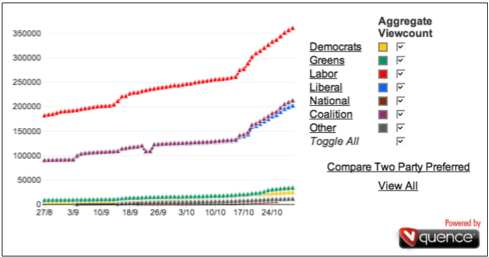
So we have all this quantitative data about social videos, which we update frequently. With it, we can create graphs of the development of view counts, comment counts, video replies and such. See for example the below image for a graph that compares the aggregate view count of the videos that were published by the main political parties in Australia during last year’s federal election. The graph shows the development of the view count over the last 2.5 months before the election in 2007.

Aggregate Viewcount Graph Federal Election Australia

At first you will notice that Labor started far above everyone else. Unfortunately we didn’t start recording view counts that early, but we assume it is due to the Kevin07 website that was launched on 7th August. In the graph, you will notice a first increase on the coalition’s view count on the 2nd September - that’s when Howard published the video for the APEC meeting 2-9 Sept 2007. Then there’s another bend on the 14th September, when Google launched it’s federal election site and we saw first videos of the Nationals going up on YouTube. The dip in the curve of the Nationals a little after that is due to a software bug. Then on the 14th October the Federal Election was actually announced and you can see the massive increase in view count from there on for all parties, ending with a huge advantage of Labor over everybody else. Interestingly enough, this also mirrors the actual outcome of the election.

So, this is the kind of information that we are now collecting at Vquence and focusing our business around.

On that background, check out a recent blog post by Judah Phillips on “Thinking about Measuring Internet Video?”. It is actually a wonderful description of the kind of things we are either offering or working on.

Using his vocabulary: we can currently provide a mix of Instream and Outstream KPI to the video advertising market. Our larger aim is to provide outstream audience metrics that are exceptional and we know how to get them regardless of where the video goes on the Internet. Our technology plan centers around a mix of a panel-based approach (through a browser plugin) and a census-based approach (through a social network plugin for facebook et al, also using OpenID), and video duplicate identification.

This information isn’t yet published at our corporate website, which still mostly focuses on our capabilities in video aggregation, search, and publication. But we have a replacement in the making. Watch this space… :-)

Sexier new Vquence player

I’ve been meaning to write about this for a while, but haven’t found a good motivation yet. Today I stumbled across the videos from RailsConf2007 on Blip.tv and decided - this is it! I will show off the nice new sexy layout of the Vquence player with this content - after all, we are a rails shop (apart from all those other programming languages that we use).

Julian has worked over the design of the player in December and done an awesome job. The image pane’s scroll slows down as your reach the left or right border. It works similar to a scrollbar, where if you go to the middle of the image pane, it will scroll to the middle clip in the playlist. As you leave the image pane, it snaps back to focus on the clip that you are currently watching.

The new player also has a lot more text in it. As you mouse over the images, you get the titles of the clips. As you click on the (i) button, you get the annotations of the current clip (click (i) again to make it go away). At the beginning of each clip, there’s a small text reminder at the top that a click on the video will take you to the full video.

And finally - to give the video more space, the transport bar actually disappears as you keep watching and stop interacting with the player. This gives it more of a sit-back experience. The possibility to activate the full-screen display also adds to this experience.

Overall, I am really thrilled how far we have taken the player. Enjoy!

(But should you have any feedback or suggestions for improvement, feel free to shoot me an email or leave a comment.)

Vquence at Webjam

Tonight is Webjam night in Sydney and I have custom created a Vquence for this occasion on my favorite band right now: “My Chemical Romance”. I’ll be presenting in a slide show how to go about getting it to here:

Am looking forward to getting to know other Web 2.0 players in Sydney!

Usability testing for Web2.0 sites

Let’s say: you run a Web2.0 site. And you know it’s not perfect (no website is perfect - people just make do with what’s there). And you are actually determined to improve it. Who do you ask?

No: I am not asking you to send me a quote - go away! I don’t want to spend thousands of dollars on a professional agency to undertake usability testing and get some cool new designs for the interface and processes. Chances are I find out later that this apparently “perfect” solution makes processes too complex or uses the wrong colours for our audience or … well, it’s wrong again in some aspect. Our Web 2.0 site is targeted at teenagers and I predict that no agency out there can give me the right feedback - simply because they are corporate.

The solution is very simple indeed - and it will make for a few very happy teenagers - happy to be able to have input into a new online site and to tell their friends about it. All you need to do is ask a few intelligent and outspoken teenagers for a bit of time and invite them to your office or home for a few hours to do some semi-formal usability testing. You shall be amazed about the results!

I’d like to say special thanks to Charlotte, Will, Peter and Alice for taking the time on Friday for 3 hours to do a thorough usability testing exercise with us at Vquence. It was a lot of fun - and I dare say: for everyone involved. Here is the schedule that we followed.

We started with an introductory 30 min where everybody, including the testers, introduced themselves and we started talking about what we do online, what we love and what we hate - including the testers. This is important because you break down the barriers and create trust.

Then we had a questionnaire for them to fill in (the middle part of the schedule). It took them through the functionality of the site in a logical manner, asking for feedback on the design, the processes, the functionality and the usefulness of the site.

Then we got together again to “vent” all of that frustration. And … boy, did we get feedback! It was totally awesome - the positive feedback actually made us value our previous work a lot higher - and the negative feedback was great because it tells us what to fix or improve. They were quite direct in their criticism and had some great ideas for improvements. Since they know their world and what makes them and their friends click, they are really the only ones who can tell you what is great and what sucks.

Once we fix all the things that we’ve been told, we should probably do another round of testing - with some new teenage blood. But for now, I am extremely happy with the feedback we got - and will need to look for further investment to get all of this great feedback rolled out! ;-)

Thanks guys!!

A long story of logins

The new vquence website, that lets you create vquences yourself, has been out for more than a week now. But we were unhappy to talk about it because the login code was screwed up. It all happened in the last minute: a crash between the beauty of design and the reality of Web browsers. Who won? Well …

Between Julian and I, we had decided to do a cool sliding effect for user login and signup (try it out on the site - it’s hard to explain in words). Very Web 2.0 - very shiny. It all worked well and we quite happily ran the code for a long time.

Then came the time that we wanted to give outside users access and that our more security-conscious people suggested to exchange user passwords over https rather than in plaintext. Fair enough - no worries - quick fix to change the protocol, right? Bah - all wrong - because now you have http and https elements on the same Web page needing to talk to each other. Big sandboxing issue in Firefox - and worse in IE.

Anyway - I leave the details of this problem - and the ultimate solution for it - to somebody better suited to explaining it. I will only say that it has cost us days of pain and suffering and bug #93 will forever be remembered.

But - we fixed it - and now you can happily create video playlists on www.vquence.com and share/socialise them. I have one on my facebook page. :-)

Vquence gets its first real competitor

Today, I heard about SlapVid. SlapVid is a demonstrator built on a p2p system built by 4 CMU graduates and supported by Y Combinator. The SlapVid flash player has similar functionality to the Vquence player in that it concatenates slices of videos from a collection. And - like we did for the Vquence alpha - SlapVid’s website presents the top videos from youtube in their demonstrator. Seems a bit of a copycat. ;)

At the moment, you cannot generate SlapStrips yet, but they’re progressing toward it. So are we - and fast - expect to author vquences by the end of this week!

I for one welcome the arrival of our first competitor (even though SlapVid may not be called a complete competitor, because they largely rely on p2p to provide their service, while we rely on our own infrastructure mainly, which will allow much better control over the user experience). A competitor in the market place validates your ideas and business model. It makes the discussion a lot easier than if you have to explain the concept over and over again. Also, if somebody else is doing it, we’re obviously doing something right. Let’s just try and stay ahead of them. ;)

So you're waiting for the Vquence beta?

Last night we rolled out some new code onto the Vquence site. We are now fairly happy with the process that we have put in place for creating vquences. That is, us geeks at Vquence are - so we are now allowing friends and family to help us kick it into shape in a closed beta trial. We expect the public beta is not far off now.

YouTube's new player misses the point

Last week, YouTube brought out a new flash video player. The player had thumbnails of related videos from YouTube content included directly into the embedded video as you moused over it. This provides access to other YouTube videos through any embedded video.

People who have seen what we do over at Vquence noticed the similarity in the user interfaces. They also assumed that therefore the functionality must be the same. However, quite the opposite is true.

YouTube is a video hosting site. People upload videos there to publish them and most probably to re-embed them into their own websites. When you use video hosting, you don’t want your video hosting provider to suddenly display other videos on top of the one you have embedded, since that changes the perception of the page that you have created around the video.

Indeed, YouTube had to take back the mouse-over functionality one day after they introduced it because their users gave them negative feedback.

In contrast, Vquence is a video aggregator. The Vquence video player is for “playlists” (rather: slicecasts or vquences) of videos collected from multiple hosting sites. So, when you embed the Vquence player, you expect display of and easy access to all the videos in the slicecast. It is a very different concept: the aim is not the embedding of a video, but rather the recommendation of multiple videos to your readers. Vquences enable you to share your bookmarked videos in a viewer-friendly fashion. It’s not about embedding videos in your page - it’s about providing hyperlinks to videos by using videos.

Vquence Teaser Site goes online

Last week, we put a new front page on http://www.vqslices.com/, which shows off the concept of “vquences”. A vquence is essentially a collection of video bookmarks presented as a “video mash-up” and in an embeddable “widget”. Or without bullshit: we concatenate 10sec previews of the bookmarked videos into a playlist, which is embeddable into other sites. And since it’s embeddable - here is an example vquence:

This vquence shows some snippets from Missy Higgins videos - she’s such a great singer! If you cannot see it here (due to planet sanetisation), go to http://www.vqslices.com/vq/dXelFQeQCr3kFQaby-aaea .

Vquences are a powerful concept and we’re right now working on the beta website, which will bring authoring to you out there, so you can create your own vquences. Also, we are working towards providing a REST API to register sites with Vquence, and RSS feeds, so you can always keep up to date on the latest vquences. Lot’s of other developments in the pipeline here…

Taglines and Web 2.0

Have you ever tried to come up with a good tagline for a new company? In the times of Web 2.0, taglines seem to matter a lot. They are the essence of the elevator pitch. But because they can only be a maximum of 3-4 words long, they tend to be rather meaning less and just contain content-free Web 2.0 buzzwords. In fact, this has become such a fashion that there is a Web 2.0 bullshit generator.

Up until recently, we had the tagline “Making Video Clickable” for Vquence, because we believed that our slicecasting technology helps hyperlink between videos and make video more web-like. However, this phrase is a poor representation of what Vquence does, what services we offer, and how we’re going to make life better. So, a new tagline was in order.

But what a challenge! You have no idea how difficult it is to come up with three words that capture what a company is about! Sure - I have been to management training courses and they say it is an artform to come up with a good mission statement for a company and that some companies spend tens of thousands of dollars just to get it right. But a tagline!? Well, let me tell you, a tagline is harder than a mission statement - probably because of the word count restriction.

We discussed for weeks, we even used the bullshit generator and it became rather ridiculous - in short, we did some serious brainstorming (whenever we were not coding). Finally, our newest team member came up with what we have for now accepted as our new tagline. It has all the key ingredients: it is techy, personal, raises curiosity, but is still meaningful (we hope). So, let me present our shiny new tagline: “Vquence - Slicecasting your internet”.

And if that’s totally meaningless to you, then you need to go to www.vquence.com and try out our slicecasts to make it real. Hmmm, I like it. :-)

Vquence technology progress

I’ve been rather quiet about what we actually do at Vquence, but I have to say that the recent months of intense development are coming to fruition and we are secretly enjoying the play with the first version of our new product, while at the same time working on bugs, new features, and on a scalable setup.

For those who have read our website and recent blog entries it will be clear that we are working on video, using flash/flex for the development of a playlist player, and are developing a web application service around these playlists using Ruby on Rails. If you want to be one of the first to try it, you can join our mailing list to be invited to a closed user group trial, which we will start a few weeks from now.

For those curious to find out what we really do, we’ve created a white paper - email me and I will shoot it through.

Rails and plugins

I’ve come to really love working with Ruby on Rails - it forces a structured approach of Web development upon you which helps enough to get you organised, but doesn’t get in the way of being productive.

I’ve also learnt to search for plugins or gems whenever I need a specific functionality because more often than not somebody has already solved the problem that I am trying to address.

Today I played with Andy Singleton’s GUID plugin (global unique identifier) and found a bug. I haven’t found a way to publish the solution through the rails wiki (I’m really new to the community), so I’m posting it here. I’ve also sent Andy an email, so hopefully the issue will get addressed.

Here is what happend.

I got the plugin working on my development computer and wanted to test it on another machine. However, the plugin gave me the following error message: #{RAILS_ROOT}/vendor/plugins/guid/lib/uuidtools.rb:235:in `timestamp_create' #{RAILS_ROOT}/vendor/plugins/guid/lib/uuidtools.rb:225:in `timestamp_create' #{RAILS_ROOT}/vendor/plugins/guid/lib/usesguid.rb:25:in `after_initialize'

After some digging I found that it uses the MAC address of the computer for seeding the GUID. To query the MAC address, it calls ifconfig (or ipconfig on a Windows machine) - which is fair enough. It has several cases that it goes through. However, the case of my machine was missing and the code did not address a nil return from the get_mac_address function.

My case was simple to solve: my MAC address comes in upper case characters, while the code only tested for lower-case characters. So, I added another parsing condition for my case: if mac_addresses.size == 0 ifconfig_output = `/sbin/ifconfig | grep HWaddr | cut -c39-` mac_addresses = ifconfig_output.scan( Regexp.new("(#{(["[0-9A-F]{2}"] * 6).join(":")})")) end

The generic problem is harder to solve - and maybe it should not be solved, but fail on the programmer, since he/she is trying to roll out GUID calculation on a machine where the program is unable to calculate a MAC address…

Hmmm…

New Vquence Website

I’m excited to present the all new http://www.vquence.com/ website.

As you may know, Vquence is the online video startup that Chris Gilbey and I have created over the past months. We now have a great team of people working with us.

We’ve worked hard on our new Web presence to get a nice modern logo and Web design, to produce some good pictures to describe what we actually do, and to give a sneak preview of our technology.

Go check out the video on the front page. It’s a flash player (sorry, not Annodex yet) and has some awesome functionality hidden inside - thanks to Peter Withers, Michael Dale and Jamie Madden. Click on the video slices as they are playing. And notice how all the full videos are hosted on different video hosting sites (sorry to all those hosting providers who missed out - we simply haven’t got enough people working for us yet ;).

Thanks to Julian Frumar and Alister Walters for all the great design work, to Chris Gilbey and Richard McKinnon for the copy, and to Matt Moor and John Ferlito for getting the hosting under control with some cool scripts to be used for future rollouts of our final product.

Have fun!

Video hosting and autoplay

This week, we’ve been working hard towards getting the corporate website for my new company Vquence up. As part of that, we shot videos of most of our key people in an attempt to “eat our own dogfood”: show off our slicecasting technology, which comes as embeddable vquences (video sequences). The idea is to extract slices from a set of videos, collate them together like highlights, and make them clickable - so people can click through to the full length videos.

On our website, we decided to show the vquence with a clickthrough to full-length videos hosted at different video hosting sites, including not just the popular YouTube and Google video sites, but also sites such as Metacafe, Guba, iFilm, blip.tv, Grouper, Gofish, VSocial or DailyMotion.

On click-through, we wanted to have the embedded videos from those hosting sites to start playback directly without enforcing people to make another click on the image. This has turned out as quite a challenge.

Not every video hosting site that supports embedding also supports autoplay. Here’s what I found.

The following sites provide an autoplay parameter for their embed tags (only key components shown in the code):

  • youtube:
    <embed src="http://www.youtube.com/v/xxxxxx&**autoplay=1**" type="application/x-shockwave-flash" />
  • google video:
    <embed type="application/x-shockwave-flash" src="http://video.google.com/googleplayer.swf?docId=-xxxxxxx&hl=en-AU" FlashVars="**autoPlay=true**&playerMode=embedded"/>
  • metacafe:
    <embed src="http://www.metacafe.com/fplayer/xxxx/title_yyy.swf?**playerVars=autoPlay=yes**" type="application/x-shockwave-flash"/>
  • blip.tv:
    <embed src="http://blip.tv/scripts/flash/blipplayer.swf?**autoStart=true** &file=http://blip.tv/file/get/xxxxxx.flv%3Fsource%3D3" type="application/x-shockwave-flash" />
  • DailyMotion:
    <embed src="http://www.dailymotion.com/flash/flvplayer.swf?xxxxxx" flashvars="url=http%3A%2F%2Fwww.dailymotion.com%2Fget%2F14%2F320x240 %2Fflv%2Fxxxx.flv%3Fkey%3Dxxxxxx.flv&duration=68&**autoStart=1**" type="application/x-shockwave-flash"/>
  • Grouper:
    <embed src="http://grouper.com/mtg/mtgPlayer.swf?v=1.7" FlashVars="**ap=1**&mu=0&rf=-1&vfver=8&extid=-1&extsite=-1&ml=xxxxxx" type="application/x-shockwave-flash"/>
  • GoFish:
    <embed src="http://www.gofish.com/player/fwplayer.swf" type="application/x-shockwave-flash" FlashVars="&loc=blog&gf=true&ns=false&fs=false&gfid=xxxxxx&c=grey &**autoPlay=true**&getAd=false&wm=false&ct=true&tb=false&svr=www.gofish.com:80">
  • VSocial:
    <embed src="http://static.vsocial.com/flash/ups.swf?d=yyyy&**a=1**&s=xxxxxx"/> - be warned though that their player takes a third for menu stuff

I know that both Guba and iFilm have an autoplay feature since the video on their websites plays without the need for an additional activation, but I couldn’t find out what parameters were needed or which other flash player I would need to use.

Revver simply refuses to support this feature reasoning that nobody would want a video to play back automatically without the need for an interaction. Guys - come on! Nowadays videos live on their own Web page. A person that is navigating to that Webpage and knows what they are navigating to shouldn’t really have to jump an additional hurdle just to get your videos to play!

BTW: I was unable to manage to upload a video to Metacafe from my Mac inside Firefox, although I tried for 3 days. :-( - worked now!

I do not claim to have tested all the video hosting sites out there. But these are a good selection and my current state of experience.

Ah yes: go and enjoy our new site - http://www.vquence.com/ - and don’t forget to check out the videos at the bottom of the front page.

$1.65bn for YouTube - will Google now finally offer video search?

No, Google do not offer a video search service, don’t be blinded. Time and time again I have to explain that Google’s video.google.com is a video hosting service, not a horizontal video search service. They do not follow their own mission with Google video, but offer search only on their own collection of content, i.e. they offer vertical search and not search on “the world’s” video, which is what horizontal search is about.

And now they have acquired YouTube - btw: this was a really cheap deal, too, through a masterly financial stragey. But I diverge - I am not a market analyst, but a technologist. And I want to share what I see as an immense opportunity for Google in this deal.

Let me go back in history: Google started video.google.com because there was not enough video content on the Web and thus a dedicated video search engine didn’t make much sense. So they ran a dual strategy to get content on the Web: they made it simple for consumers to upload their content thus starting the wave of consumer-created (and consumer-mediated) content. And they mediated content from the old media industry to go online. This instantly put Google into the video hosting business.

Fast-forward a year and you find YouTube did a better job at providing consumers with a video hosting service. So, Google buys them. With what intention? To have a second video hosting business? Maybe… but to be quite honest, I have a different take on this.

This is the chance for Google to turn the Google brand away from video hosting and back to horizontal video search. With YouTube they have a channel to move their existing corporate customers and their upload users to a more successful hosting site. Then they can get their core brand back into search.

Bah - gotta get back to coding, so our company is ready for when the time comes!

Best practice in Web video publication

I’ve spent a lot of time recently analysing video on the Web.

YouTube and Google Video introduced what seems to be the standard now: videos get published on what I like to call a “host page”. This is one webpage completely dedicated to this video.

Why are there still so many videos out there that get published through a hyperlink behind two words of text instead of giving them proper recognition?

Think about it: the creation of a video usually costs a lot of effort and when it’s done, it needs a proper presentation. Hiding it behind a hyperlink is like putting your blog up on an ftp server in pdf format.

So, what information has to be on a video host page?

Best practice is to have an embeddable video player on the host page that displays a keyframe.

Other information that typically resides on a host page is a short textual description of the video, its duration, who published it, who created it, license rights (check out Creative Commons for this), tags & category attributions, comments from viewers, number of page views, and a description of how to use this thing in other environments, such as how to embed it in blogs or how to download it to the iPod or PSP.

We don’t need Google or YouTube to do this for us. We can publish video in that way ourselves. Well, maybe apart from the bit about transcoding to the iPod or PSP. Incidentally, is there any open source SW around to do that?

We can transcode our videos to Ogg Theora using ffmpeg2theora and then publish it with the embedded java theora player Cortado. Then we just need to create our own host page in html.

All we need now are a few more plugins for common Web content management systems like WordPress or drupal to simplify this process even more. Here’s your Friday afternoon challenge. :-)

Making your video discoverable

Videos will be everywhere on the web! Yes, cope with it: soon the majority of videos won’t be with some hosting site like youtube, but it will reside on our private servers, on company servers, actually on any and all web servers. And there will be interesting stuff, but it will be hard to find.

Yes, history will repeat itself again and finding those videos on the Web that satisfy our need - be it for information or entertainment - will be a nightmare. Why? Because google’s pagerank (and many other ranking algorithms) rely on Web pages pointing to the videos to give them a higher rank. However, the way in which videos are currently published is through embedding them into Web pages (let’s call such a page the “embedding page”). Thus, the link analysis will actually return the pagerank for the embedding page - but not for the video itself!

Now, if the embedding page can actually be seen as representative for the video because the only reason that the webpage exists is to publish the video and its annotations, then the pagerank for the embedding page is actually the same as the pagerank for the video. This is the case for google video and for youtube and for many other hosting sites.

However, you and I mostly publish our videos in blogs or on Web pages that describe more than just the video - some will even have several videos embedded. This is where the chaos for a Web search engine for videos begins. And this is where the discoverability of your videos through video search engines ends.

Here is the solution.

Just as we do with normal Web pages, we have to introduce SEO (search engine optimisation) for videos. That means, we have to make it easier for the search engines to find out information about our videos, i.e. to index and rank them.

Because videos are binary data, a common Web search engine cannot extract information about this Web resource directly from it (let’s ignore signal analysis and automatic content analysis approaches for the moment). We have to help the search engine.

The solution is to have a text file sitting “next” to the actual video file which contains indexable text about the video. It will have all the annotations, meta data, tags, copyright information and other textual meta information that search engines require to index and rank it better. This text file is an indexable textual representation of the video.

So, whenever a video search engine reaches a video in a crawl, it will check out this text file for its indexing work. If this text file is HTML, then people may link directly to it and it will be included in the pagerank calculations again. If it is a XML file, there should be a simple way to transcode it to HTML, e.g. via a xslt script, so links can go there directly again.

So much for the theory: here comes the practice.

For every video file (and incidentally it would work for audio, too), you should start writing a CMML file and publish it on your Web server together with the original. Here is a xslt script that you can use to transcode CMML to HTML. If you actually use Ogg Theora as your Video publishing format, you can even publish Annodex videos and make direct access to the clips that you defined in CMML and to time offsets possible by using the Apache Annodex module. Try using it in your blog with the external embedding of the Annodex Firefox extension.

When we’ve done this, all that remains is to encourage the video search engines to exploit the CMML data in their crawls. :)